Archives for category: Vermont

IMG_3193

I was up in Vermont this past weekend extending my birthday celebrations with old and new friends and, of course, delicious food. I hesitated before posting because I didn’t get the best food shots (cooking in the evening) but one dish in particular was so tasty I wanted to share. AND it makes use of those preserved lemons you made after reading my recent post. It’s so addictive, and easy to make, this will go into my regular rotation.

IMG_3218

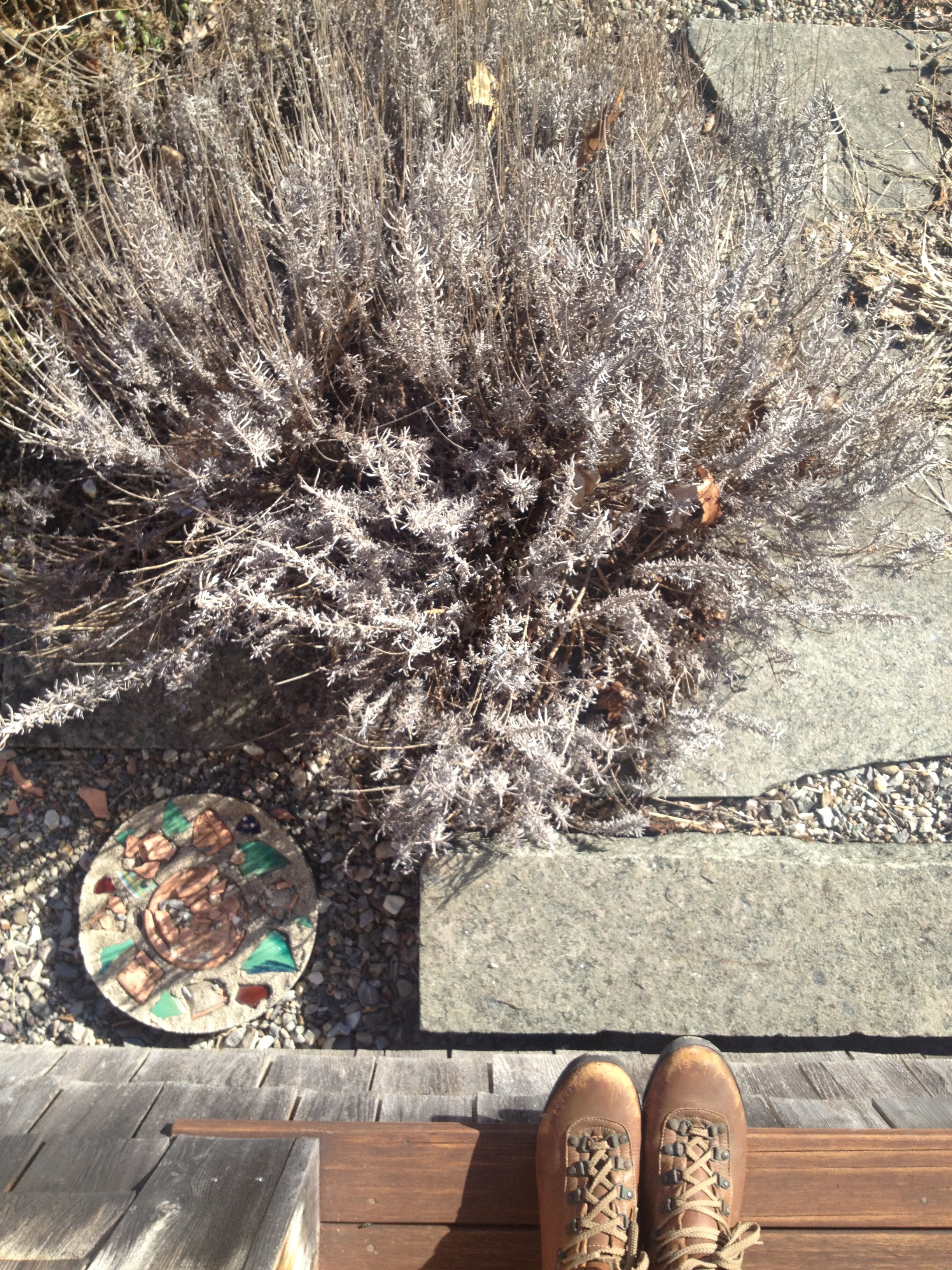
March in Vermont. You can hardly call it spring. It’s either mud season or maple sugaring season, depending on how charitable you feel. These are some shots taken in the surroundings of my parents’ house, including the not-quite-frozen pond and hardy grasses that survived the winter. Check out the cerulean sky!

IMG_3220

One reason I haven’t posted too much lately — aside from concussion recovery — has been wanting to focus more on vegan and vegetarian food and less on meat-centered dishes, not that that was ever my focus. A goal of mine this year is to move more gradually in the direction of an animal-free diet. I’m about 80% there already but it’s that last 20% I find challenging. This spicy carrot salad is vegan (if you omit the optional Greek yogurt) and goes great with a number of main dishes.

This weekend I served it with a very non-vegan leg of lamb, the recipe of which came from the cookbook Jerusalem. The meat was from Duclos’s Sheep Farm in Weybridge, which I mentioned here last summer. From “mostly food” to “mostly vegan!” It’s a gradual process…

Ok, carrots. I love this dish because it’s richness comes from the onion and spices and not from butter or dairy or lots of oil. You can adjust the level of spiciness to your liking, but the recipe below is fairly mild. You could serve this with a warm freekah salad, which I should probably post about next. You cook the freekah just as you would brown rice and add to it caramelized shallots, scallions, and lots of fresh parsley. Dig in.

IMG_3228

Spicy carrot salad
Adapted from Plenty

Serves 4–6

2 lbs carrots
1/3 c olive oil
1 medium onion, finely chopped
1 tsp maple syrup
3 garlic cloves, crushed
1 medium jalapeño, finely chopped
1 scallion, green and white parts, finely chopped
1/8 tsp ground cloves
1/4 tsp ground ginger
1/2 tsp ground coriander
3/4 tsp ground cinnamon
1 tsp sweet paprika
1 tsp ground cumin
1 tbsp white wine vinegar
2 tbsp chopped preserved lemon (recipe here)
salt
2 1/2 c cilantro leaves, roughly chopped
1/2 c Greek yogurt, optional

Peel the carrots and cut them into semicircles 1/2 inch thick. Place in a large saucepan covered by cold salted water and bring to a boil. Turn down the heat and simmer for about 10 minutes until tender but still crunchy. Drain in a colander and leave to cool and dry out.

Heat the oil in a large pan and sauté the onion for 12 minutes on medium heat until soft and starting to brown. Add the cooked carrots and all the remaining ingredients, apart from the cilantro and yogurt. Mix well. Remove from heat. Season with salt, stir, and leave to cool.

Before serving, stir in the cilantro, and adjust the seasoning if necessary. Serve with a dollop of yogurt or, to keep it vegan, drizzle with olive oil. Garnish with a little more cilantro.

Below is Wolfgang Laib’s installation at MoMA which just ended on Monday: hazelnut pollen in the main atrium. Beautiful, meditative, and beckoning spring.

IMG_3049

I came home from Vermont on Labor Day with a weighty bag of small plum-like tomatoes from my stepmother’s garden. I was housesitting for her and my father and part of my laborious duties included picking the ripe fruits from their vines. While the Sun Golds burst with the flavors of sun and summer, these more Roma-like tomatoes seemed better suited to gazpacho or a sauce.

The bag sat on my counter in Brooklyn for most of last week until it occurred to me to roast them, concentrating their flavors for a sweeter, more flavorful punch. I like raw tomatoes, I do. They’re one of August and September’s exquisite pleasures: slicing the juicy fruit, whether beefsteak or heirloom, seeds spilling over the edge of the cutting board. Layered with good buffalo mozzarella and basil, or just biting into one like a peach. But I find, after a while, I want my tomatoes cooked. I want the tastes condensed, the flavors warm. Maybe it’s just summer turning into fall.

So I decided I needed more tomatoes. I swung by my local farmer’s market Saturday after the tornado/tornahdo left Brooklyn and the sun came out blazing. A stand had a $1/lb bin of bruised tomatoes that needed a home – I was more than happy to adopt these forsaken ones. I lugged six pounds home for six bucks.

Once home I sliced all the tomatoes and arranged on a baking sheet, drizzling olive oil and salt on top. I roasted them in a 225 degree oven for one hour, a little more, turning once, until they were shriveled and syrupy. These are great to eat just like this – tossed with pasta, or on toast, in a salad, or mixed with rice. But I thought marinated in olive oil with the basil and garlic I brought home from Vermont would be even better. So quite unintentionally I found myself stuffing the roasted tomatoes into glass Ball jars and sealing their lids in baths of boiling water.

A friend came by and said, “you’re canning!” And so I was. Sort of. But I think of it more like cheating – preserving the rich flavors of summer without spending days on a factory line in my kitchen. It took all of a couple of hours to fill four Ball jars this weekend. I know that won’t get me through the winter, let alone fall. September? Maybe.

Roasted, marinated tomatoes, for fall

Tomatoes, any variety, the cheaper/uglier the better
Olive oil
Garlic
Salt
Chili peppers, optional
Basil, optional

1. Slice the tomatoes into wedges (unless very small in which case halve them). Arrange on a baking sheet and drizzle with olive oil and salt. Bake at 225 F for at least one hour, and up to one and a half hours.

2. Cool completely before transferring to a Ball or Mason jar with a sealing lid. Add a few cloves of crushed garlic to each jar, also adding basil and small dried peppers if you’d like. I add a dash more of Maldon salt. Pour olive oil in the jar until the tomatoes are coated and marinating in the oil.

3. Bring a large pot of water to boil. Turn down the heat to a vigorous simmer and add your jars with the lids on tight. Let sit in the simmering water for at least five minutes, or until the jars are sealed and the lid doesn’t pop when you push on the center.

Last Wednesday I was waiting for the F train at Jay St-MetroTech, trying to make a 9 am meeting near the Flat Iron. I forgot to bring reading material for the train, so wandered over to the news and candy kiosk in the middle of the platform. For a couple years I’d buy the Times every Wednesday just for the dining section. The crossword was a bonus (Wednesdays: not too hard, not too easy), the arts section a boon. It was definitely worth the four quarters I’d plunk down on the tall counter of the Marcy Ave. newsstand before dashing up the stairs to catch the J train.

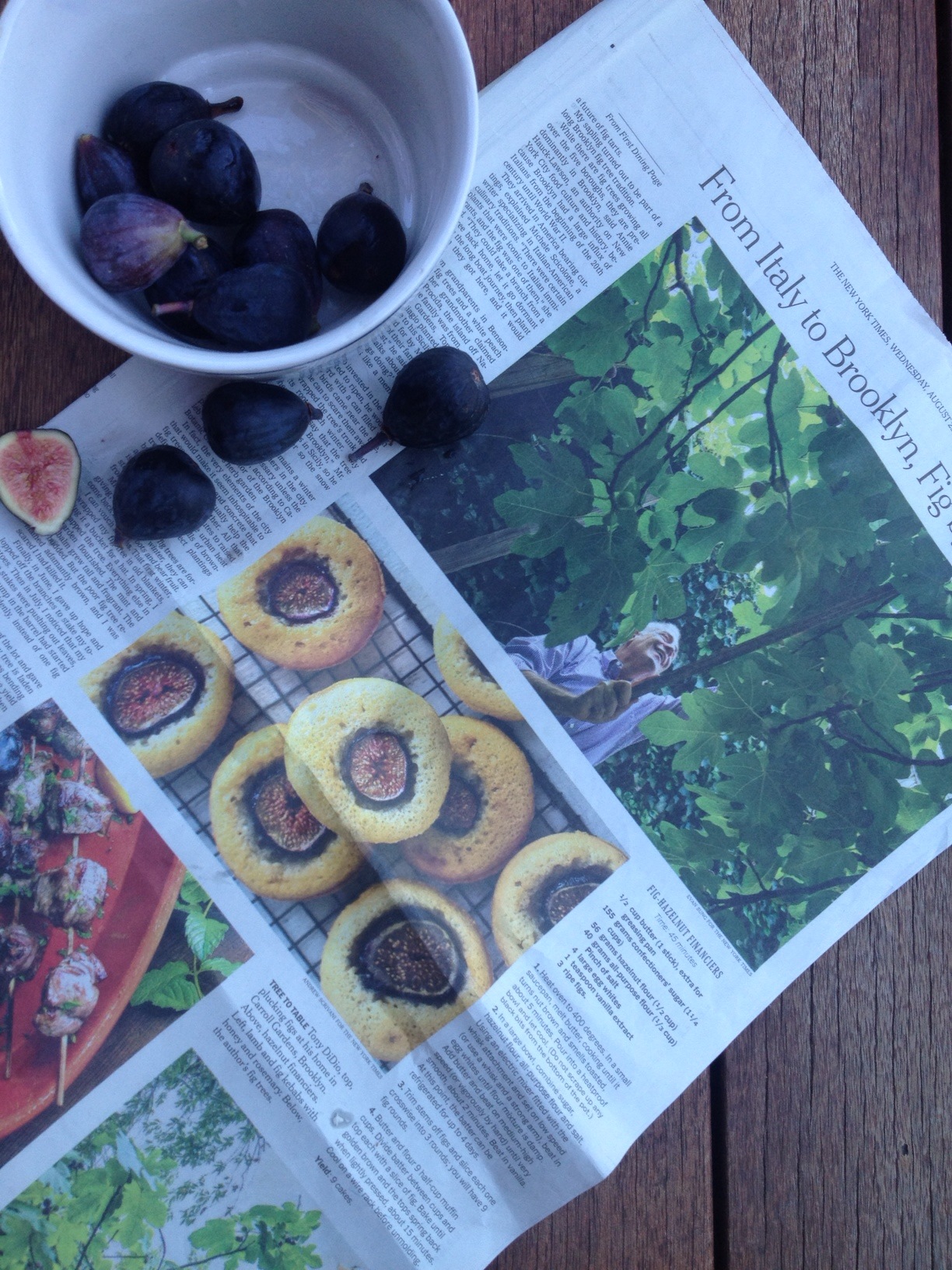
Then the price of the paper creeped to $1.50, before becoming $2 and $2.25. And this past year, the price went up to $2.50. Now it’s a rare Wednesday when I get ink on my hands in pursuit of the latest restaurant review. But I was glad I splurged this week, if only for Melissa Clark’s treatise on figs, “Italy to Brooklyn, Fig by Fig.” Did you know there are fig trees growing all over Brooklyn, in large part a holdover because of the borough’s influx of Italians in the first half of the twentieth century?

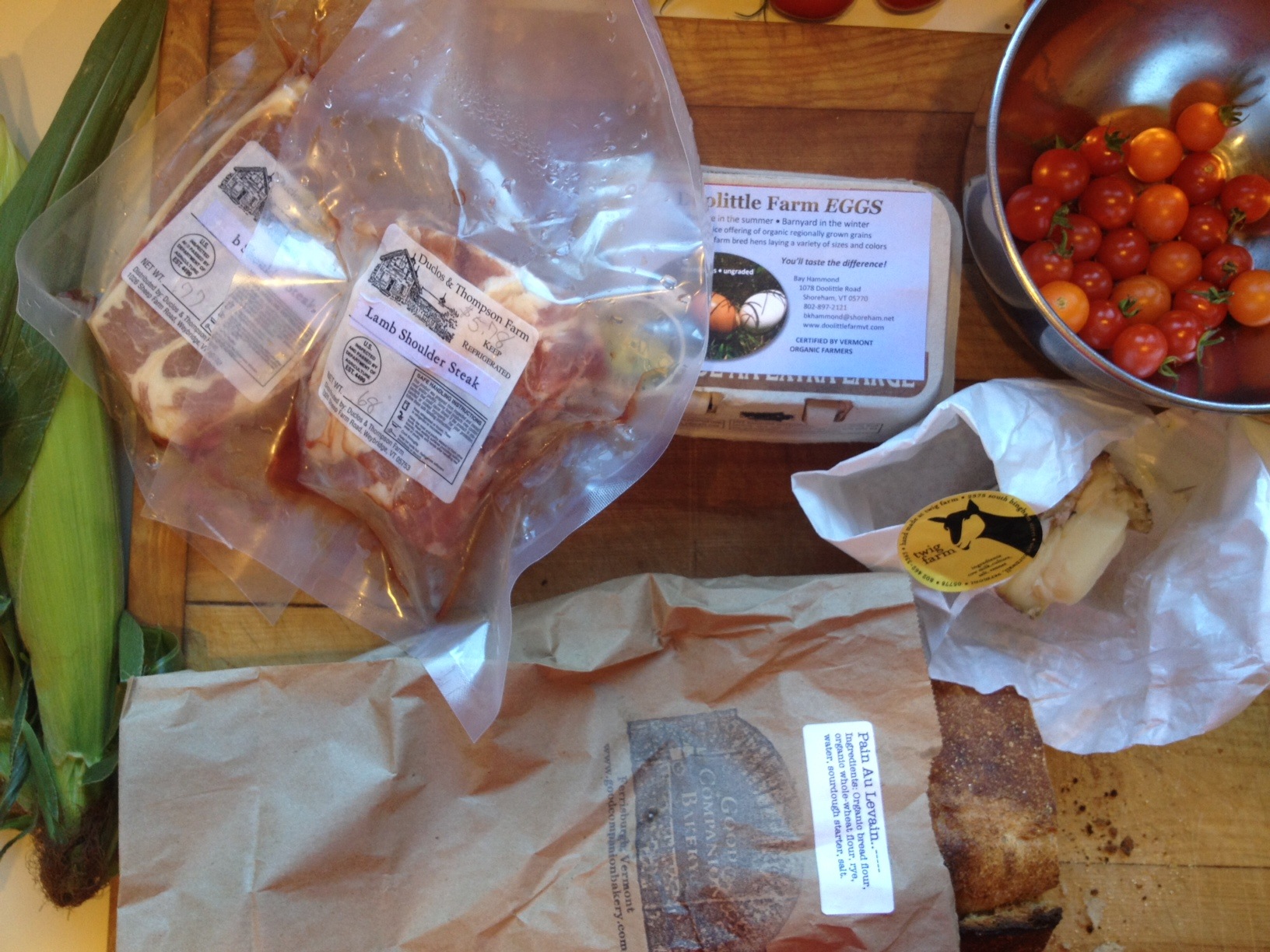
On Friday, when hastily throwing a bag together for a last-minute trip to Vermont, I tossed the paper into my duffle, wanting to try Clark’s recipes for financiers and lamb-and-fig skewers. If figs can grow in NYC, I reasoned, surely someone in Vermont is growing them. So yesterday morning I woke up early, stopped off at Vergennes Laundry for a chocolate croissant and coffee (my Saturday morning ritual when I’m here), then drove down to Middlebury for the farmer’s market. Got the requisite pan au levain from Good Companion Bakery, tomme from Twig farm, bacon from Kate (North Branch Farm), eggs from Doolittle, all the while keeping my eyes open for figs. I saw none. Apples and plums of all varieties. Watermelon even. I considered using local plums in place of figs in the recipes, but decided to try the co-op. They had them! Black mission figs. Unfortunately they were from California, not Vermont, but I picked them up anyway. I had my heart set on those recipes.

My last errand in town yesterday was to pick up lamb for the skewers from a sheep farm, outside of town, down a dirt road. Kate tipped me off to the farm, and its honor system — you walk into a little room filled with glass-fronted freezers, write down what you’re taking, leave cash in a little plastic cup, and you’re done. I found the farm, which is completely unmarked, no signage, and pulled into the driveway. There was an old farm house on the property, and a few sheds. I wondered if I was in the right place. I heard voices and laughter coming from one of the sheds, and made my way over. The door opened as two people were on their way out, and I asked if I was in the right place to buy lamb. Tom, the farmer, said I was and invited me in. He explained how the system worked. He didn’t have boneless leg of lamb so he walked me through his other cuts. In the meantime we got to chatting, and I mentioned I was up from Brooklyn, but that my parents lived nearby.

“Brooklyn?!” he exclaimed, in what I took to be mock horror. “That’s terrible,” and he sort of chuckled nervously. I chuckled, thinking I’ve heard this before. Everybody wants to live in Brooklyn these days — it’s so cool, so young, charming architecture, farmer’s markets on every corner, beautiful people riding bicycles in skirts, or with bow-tied collars, on their way to work. Then I got the sense that maybe Tom wasn’t kidding. So I asked if he was. “No! I’m not! That’s a terrible place to live! So crowded, so many people.” Then he shook his head like he was sorry for me. Sorry for my choice of residence, sorry I didn’t get to see the sun set over the Champlain Valley every day. Sorry I didn’t get to smell dirt and farmland and manure. I remember my friend Kate visiting me from Vermont some years ago when I lived in Park Slope, and she said that while she loved visiting New York, she couldn’t live there because she has to see the mountains and sunset everyday.

It’s true, we have bow ties, bicycles, and brownstones. BAM, beaches, bagels, and some of the best new food being made in the country. But it’s not Vermont. It’s so far from Vermont, despite how hard Brooklynites like me try to bridge that gap, by pickling and fermenting and gardening. But hey, at least my local farmer’s market back home has figs. For now, that’ll have to do.

Fig-Almond Financiers
adapted from Melissa Clark, The New York Times
Yields 18

Financiers are tiny French cakes made with browned butter and often almond flour. They’re traditionally made in shallow, rectangular molds, resembling small bars of gold, but can also be made by filling muffin tins part way. I didn’t have that many figs to spare so I decided to try some local plums in addition to the figs, for adorning the tops. They worked liked aces! Both the fig and plum financiers were equally good. The original recipe also calls for 1/2 c of hazelnut flour. I scoured town for hazelnut or almond flour but found none. So I decided to cheat by adding some almond paste and using a combination of pastry flour and all-purpose flour.  I cut the sugar from the original 1 1/4 cup to 1 cup, and next time I make these I’d cut it even more, to 3/4 c or even 1/2 c.

1 stick butter, plus extra for greasing the pan
1 c sugar
1/2 c whole wheat pastry flour
1/3 c all purpose flour
pinch of salt
1 1/2 tbsp almond paste
4 large egg whites
1 tsp vanilla extract
3 ripe figs (and/or Italian plums)

1. Heat the oven to 400 degrees. In a small saucepan, melt butter, cooking until it smells toasty and just starts to brown. Pour into a heatproof container and let cool.

2. In a large bowl, combine sugar, flours, and salt. Beat in egg whites until the flour mixture is damp. Add the almond paste, combine. Add the butter and whisk vigorously until very smooth, about two minutes. Beat in vanilla.

3. Trim the stems off of figs, and slice each one crosswise, into thirds.

4. Butter and flour muffin tins. (Makes 18, so unless you have lots of muffin tins you may need to re-butter tins for a second rotation.) Fill each muffin cup scant halfway and top each with a slice of fig. Bake until golden brown, about 15 minutes. Cool on a wire rack.

Lamb and Fig Skewers
adapted from Melissa Clark, The New York Times
Yields 4 servings

The original recipe calls for boneless leg of lamb, but I think this may be hard to come by. And if you do find it, it will likely run you a pretty penny. So I think you could use lamb stew meat or a bone-in cut (like the steaks I used) and cut the meat into chunks.

4 garlic cloves, minced
2 large sprigs rosemary, minced
2 tbsp fresh lime juice
1 tbsp honey
1 1/4 tsp coarse salt
1 tsp black pepper
1 tsp tamari
2 tbsp extra virgin olive oil
12 ripe figs
1 1/2 pounds lamb meat (boneless leg of lamb, chops, steak, or stew meat), cut into 1-inch chunks

1. Begin by making the marinade. In a large bowl, toss together garlic, rosemary, lime juice, honey, salt, pepper, and tamari. Stir well to dissolve the salt, then stir in the oil. Set aside a few tbsp of the marinade. Add the lamb to the bowl with the remaining marinade and toss well. Marinate if you have time (makes a difference!), in the refrigerator, for a few hours, or at room temp for 30 minutes.

2. Thread the figs on skewers, making sure to leave a little space in between each one. Brush with the marinade you set aside.

3. Get your fire started. [If you’re not grilling, you can put the figs and lambs on a baking sheet instead of skewers and bake.] Thread the lamb on the skewers, leaving space in between each piece. Grill for three to five minutes, turning once.

4. Serve with fresh mint and lime wedges.