Archives for posts with tag: Garlic

I’m back up in Vermont for two glorious weeks. The first part of this trip I’m dog-sitting for my sister Emily. To me, her pup Julius sometimes looks like the bat, Fidget, from Disney’s The Great Mouse Detective. We were lucky to be joined by my dear friend Melony and her dog Kima, who came up from Boston for the weekend.

We swam in Lake Champlain, hiked along beautiful trails flanked by wildflowers, and made some good grub. This chilled avocado soup is a snap to make and dairy-free (but can also be made with regular milk). All it takes is a few raw ingredients and a blender. No cooking, and not much chopping. We were nearly melting in the hot sun yesterday so the thought of using fire (even the grill) did not call to me. In addition to this soup we had chilled soba noodles with ginger, scallions, and wasabi (see this post from one year ago for how to make). Cold summer food for those hot summer nights, even in Vermont.

Chilled Avocado Soup
Serves 4

2 ripe avocados
2 c milk (coconut milk, whole milk, etc.)
1 clove garlic
Juice from 1/2 lime
1/4 c fresh cilantro, plus more for garnish
Chopped scallions and lime wedges, for garnish

Scoop the flesh from the avocados and place into a blender. Add the milk (in order to keep it vegan I used Coconut Dream Coconut Milk—you could use whatever milk you prefer), garlic, lime juice, and cilantro. Blend until smooth and creamy. Thin out with water or vegetable stock if too thick.

Top with chopped scallions and cilantro. Serve with fresh lime wedges. You can also serve topped with fresh crab or lobster meat for a more decadent meal. Or a dollop of sour cream, crumbled ricotta salata, or homemade crème fraîche, which I’ve been meaning to make. Eat up!

Beans (like Molly Ringwald) can be a thing of beauty. And I don’t think that’s just because I like Joni Mitchell, spent formative years in Vermont, or went to college a lentil’s throw from the Moosewood Restaurant. I’ve written here about chili, here about black beans, here about enchiladas, and here about my all-time favorite white beans from Union Square Cafe. My love for the legume, is, I feel, well documented.

I had some red kidney beans from Cayuga Pure Organics kicking around my cupboard and felt like taking them out for a spin. So I soaked them overnight without having a particular plan in mind, but knowing you can’t go wrong with having soaked beans around. They’re just too versatile. Today, after they’d bathed for close to twenty-four hours, I drained their soaking liquid, filled the pot with fresh water, threw in half an onion, three big cloves of garlic, and cranked up the heat. I cooked them for one hour until the beans were soft enough to squish in between my fingers.

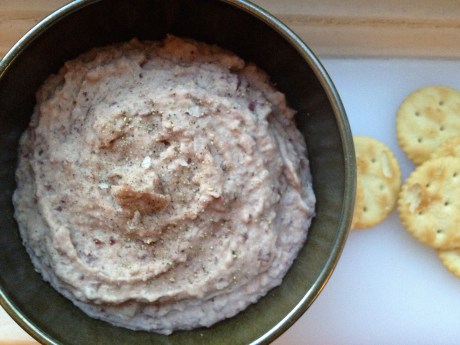
I still didn’t quite know what I was going to do when my Ninja blender caught my attention on the other end of the counter. When in doubt: puree. I decided I’d make a bean dip. I let the beans cool a little, then mostly drained them, threw them in the Ninja with the cooked onion and garlic, and poked around for what else could smooth out the dip. I settled on homemade sesame tahini that was already made, and lots of salt and pepper. But it needed a little something for body. I had leftover cooked rice so I threw in 1/4 cup of that. One ninja minute later, I had a very pretty, pink dip. In the spring or summertime I would definitely add some fresh herbs to the mix.

I can’t really think of a type of bean this recipe wouldn’t work well for, so if you have black, pinto, navy, or other kinds of beans in the larder, give it a whirl. And I mean that literally.

Pretty in Pink Bean Dip

1 c dried red kidney beans (or your favorite type of bean)
1 onion
3 cloves garlic
1/4 c tahini
1/4 c cooked rice (white or brown, short or long)
salt
pepper

Soak your beans overnight, covered by 3 inches of water. The next day, when you’re ready to roll, drain the soaking liquid, and refill the pot with water, covering the beans by about 2 inches of water. Throw in the onion, halved, and garlic cloves. Bring the water to a boil, then turn down to a simmer. Cook on low-medium heat with a slightly ajar lid until the beans are thoroughly cooked through, approximately 45 minutes to 1 hour.

Turn the heat off and let the beans come to room temperature. Now you can drain the cooking liquid completely or preserve to use later (I made extra beans—2 c dried—and preserved the liquid to make a soup with the other half of cooked beans tomorrow). Remove any skins that may have been left on the onions and garlic and discard. Transfer the beans to a blender or food processor with about 1/2 of the cooked onion and all of the garlic cloves. Add the tahini, rice, and a good pinch of salt and freshly ground black pepper. Puree until smooth.

Delicious served with your favorite cracker (I love Late July classic saltines), spread on bread, or served with raw veggies. I also admit to eating it by itself, by the spoonful. Think of it as hummus 2.0.

Postscript for my sister Hope – the onion and garlic will kill you, but try this with cooked leeks, celery, and carrots instead, and/or add 1/2 veggie bouillon.

How gorgeous is this tahini? Looks like raw honey.

While roasting chicken is a fairly simple endeavor—at least it can be; like anything I suppose it can be made as complicated as you want—I can count on one hand how many times I’ve made it during the week. For me it’s all about the weekend, Sundays in particular. The leftovers can be used in numerous ways all week and it’s just the thing to cap off a leisurely weekend. It must run in the family because my mom also tends to make roast chicken on Sundays down in Raleigh.

This past week I was perusing Cook’s Illustrated, one of the best food publications in a very crowded market. (I’d also add a plug for the Art of Eating, Edward Behr’s quarterly from Vermont.) The website featured a dish called Weeknight Roast Chicken, and it caught my attention because, as the weather turns cooler, I turn on the oven. And I have a bit of a thing for roast chicken recipes. It’s such a simple dish yet each cook has quite a personal, specific method for how to make it just so. So when a chef I like, or in this case a magazine, shares a recipe for the dish, I pay attention, curious to see if I’ll learn any new tricks. A personal favorite is Simon Hopkinson’s from his book Roast Chicken and Other Stories.

Cook’s Illustrated never fails to disappoint. With an army of testers they publish only airtight recipes. This method calls for preheating the skillet in a 450-degree oven then turning off the heat halfway through. This makes for a nicely browned bird that retains its juices. The pre-heated skillet gives the thighs a jumpstart on cooking. The seasoning is merely salt and pepper sprinkled over the bird that has been coated with a tablespoon of olive oil. I inserted half a lemon and a half a bulb of garlic to the bird’s cavity. You don’t want to crowd the bird too much with stuffing, which slows the cooking. To the skillet I added chopped carrots, shallots, and garlic cloves, sprinkled with just a little salt and olive oil. Next time I’d add a little smoked paprika to the chicken’s skin before cooking.

I served the bird with a pear-endive-blue cheese salad, dressed with a lemon-mustard vinaigrette, and a shiitake mushroom rice pilaf.

Roast Chicken, easy enough for a weeknight, proper enough for a Sunday
Adapted from Cook’s Illustrated

Kosher salt
Black pepper
1 (3 1/2 to 4 lb) whole chicken
1 tbsp olive oil or softened butter
1/2 lemon
1/2 to 1 clove of garlic
optional: a few sprigs of rosemary or thyme

1. Adjust the oven rack to its middle position and place a 12-inch ovenproof skillet (like cast iron) on the rack. Heat the oven to 450 degrees. Clean the chicken and pat dry thoroughly with a towel. Rub the entire surface with the oil or butter. Sprinkle evenly with about 1 tbsp of salt and 1/2 tsp of pepper. Place the lemon, garlic, and herbs if using into the bird’s cavity. Tie the legs together with twine and tuck the wings behind back.

2. Transfer the chicken breast-side up to the pre-heated skillet. Careful when handling the hot skillet. Roast the chicken at 450 until the breasts are 120 degrees and the thighs 135 degrees, 25 to 35 minutes. Turn off the oven and leave the chicken in for another 25 to 35 minutes, until the breasts register 160 degrees and the thighs 175.

3. Transfer to a serving dish and let the chicken rest, uncovered, for 10 minutes if you’re starving and 20 minutes if you can stand it.