I recently came upon a treasure. For the past couple of months my grandmother has been telling me of an old blue cookbook she’s had for ages that she wanted to give me. She said it contained recipes for things like Campbell’s tomato soup cake and various gelatinous desserts that might be fun to create. I couldn’t wait to get my hands on the book and start cooking, retro style.

To my chagrin we couldn’t find the book anywhere in her house; I turned closets upside down, called my mother asking if she had thrown it away, to no avail. Then recently, on my last visit, she told me to go to the upstairs kitchen and look above the sink. I dashed up the stairs, like it was Christmas morning, and there it was: a little musty, mildewy, and indeed, blue.

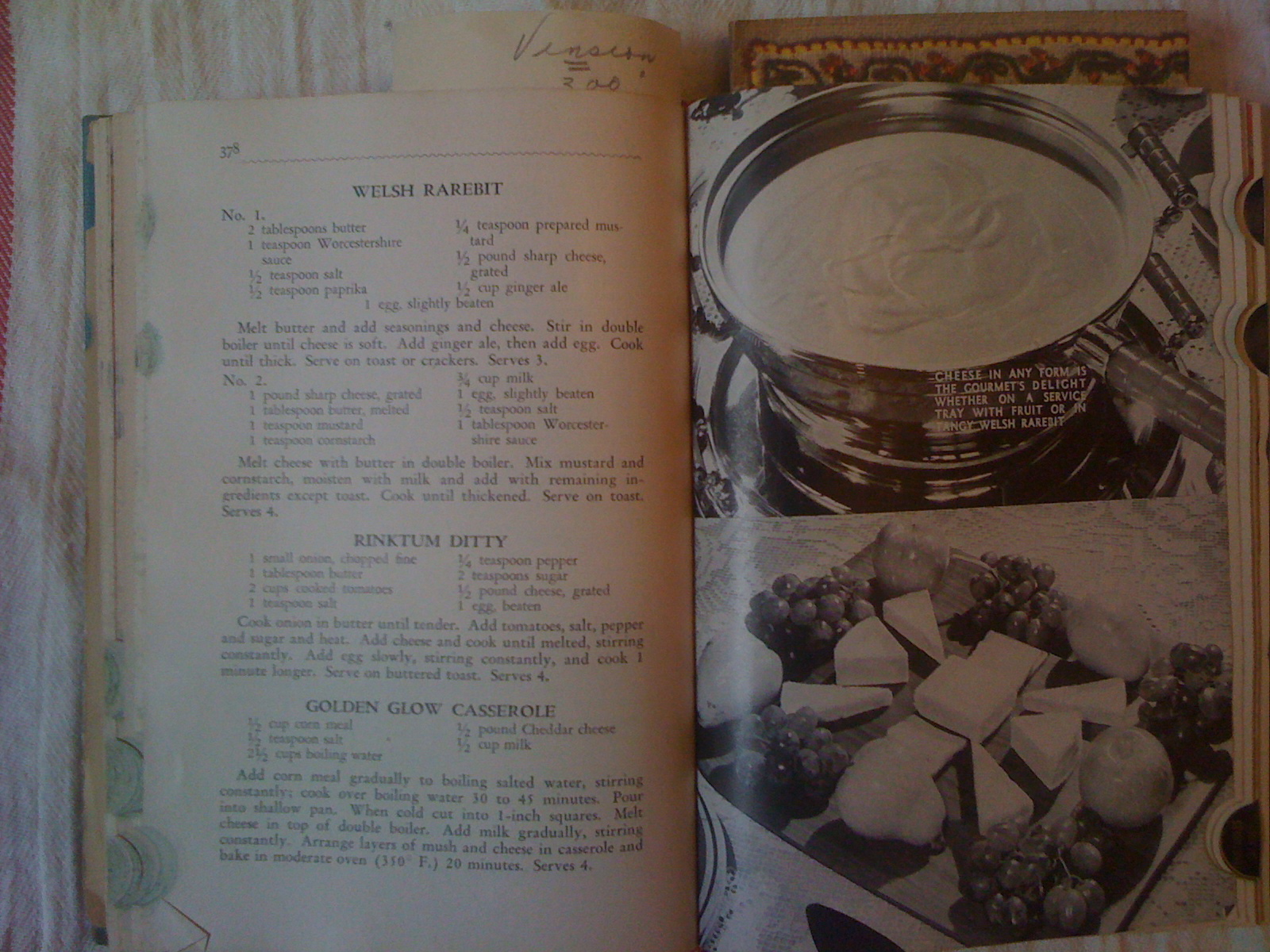
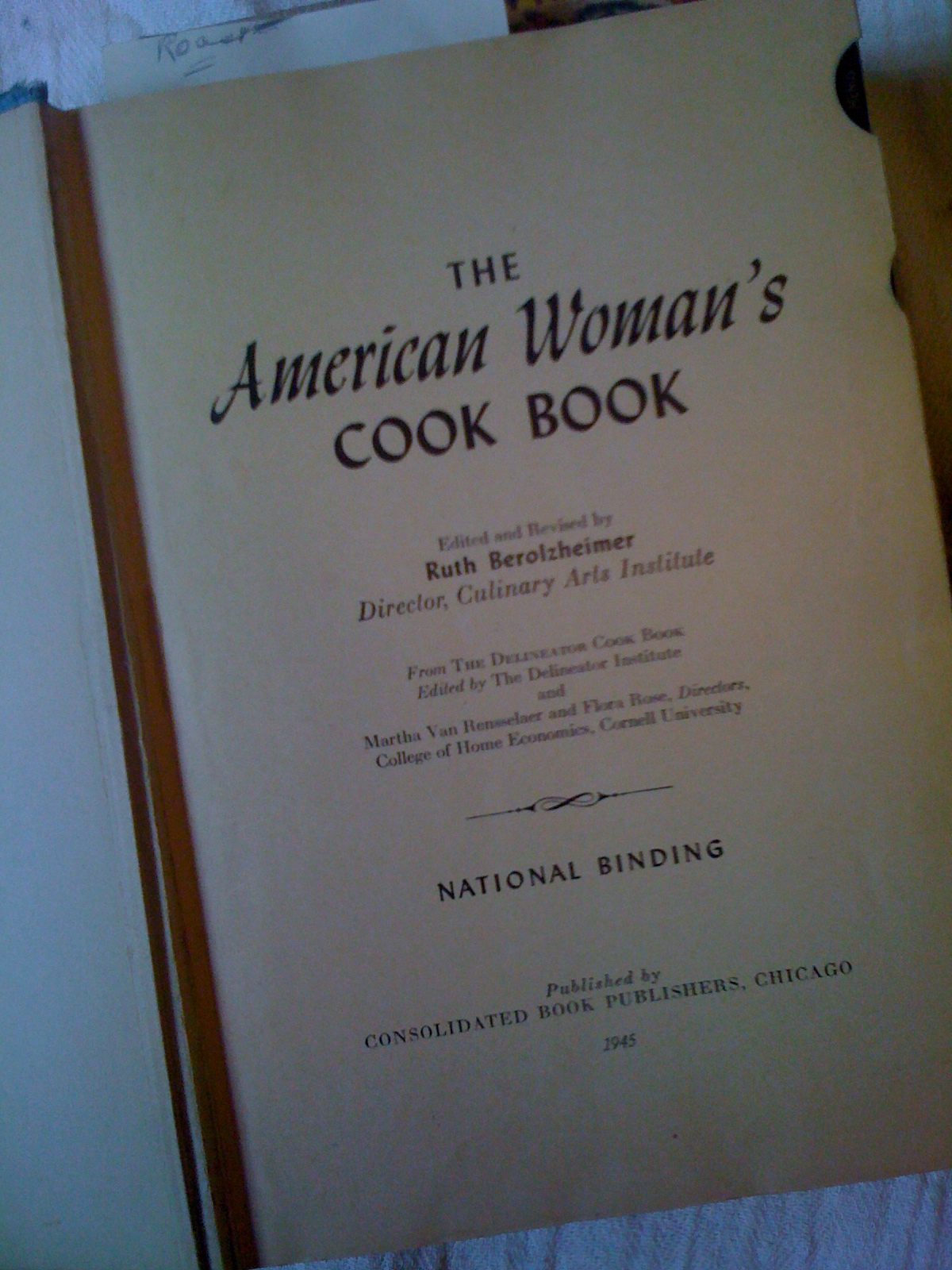
The American Woman’s Cook Book, edited by Ruth Berolzheimer, the director of the Culinary Arts Institute, was published in Chicago in 1945. Back then, my grandmother was a secretary in Manhattan at an insurance company. She traveled into the city from the Flatbush section of Brooklyn where she lived with her mother and sister. The way she remembers it, one day, someone came into the office and all the “girls” had to each buy a copy of the newly published cookbook. I should say the book was first published in 1938 and later revised by Berolzheimer in 1945.

Well there isn’t in fact a recipe for tomato soup cake, or even too many wiggly desserts. It’s a treasure of classics with recipes including: creamed salmon, bacon corn bread, popovers, welsh rarebit, réchauffé of lamb, roast beef, and coconut cream pie. Oh the good old days! When folks drank buttermilk with dinner and dissolved baking soda in water when sick. When milk was dropped off in glass jars on your doorstep and people made their own preserves and jellies.

The Table of Contents reveals a chapter for “The Lunch Box” and another for “Food for Invalids.” The Lunch Box section reads:

“As much care is needed in selecting and preparing the food for the lunch box as for the other meals served to the family. If the lunch is inadequate or lacking in food essentials throughout the year, the individual’s whole nutrition will be seriously affected, and his work will suffer. The lunch box is one of three meals, not just a ‘snack,’ and should possess the following characteristics:

1. It should be abundant in amount for a hungry, healthy individual. A little too much is better than too little.
2. It should be chosen with regard to nutritive needs of the individual, and in relation to the whole day’s food.
3. It should be clean, appetizing, wholesome and attractive.”

That’s a tall order. It’s also quite different from today when most people get a $7 burrito from Qdoba or a $5 footlong from Subway and call it a lunch. I like the idea though of a well-prepared, carefully presented lunch, in a metal box, with a thermos and cloth napkin and silverware (to say nothing of course that the woman didn’t have much of a choice whether this was the job she wanted or not, preparing cute and wholesome lunches for her husband and kids). Some of the menu suggestions are cream of spinach soup with crackers, an egg salad sandwich with lettuce, raw vegetable strips, an apple, and cup cake (that’s one lunch); or peanut butter, bacon and lettuce sandwiches, carrot sticks, cauliflowerlets, a hard-cooked egg, gingerbread, grapes, and milk (again, that’s all one lunch).

“Food for Invalids” reads, “The following general suggestions are intended to help the housewife who, in addition to her other work, has the duty of ministering to the needs of the sick and convalescent.” It recommends presenting the food as nicely as possible, and serving hot foods very hot and cold foods very cold, with meals arriving at regular intervals, perhaps with a sprig of green or a flower on the tray. Dishes in this section include banana gruel, egg drinks, kumiss (milk, yeast-cake, and sugar), rice jelly, and flaxseed lemonade. A recipe for something called “panada” says to place 2 soda or graham crackers in a bowl and add boiling water to soak the crackers, for 20-30 minutes. Lift them from the water carefully and serve on a hot saucer, serve with sugar and cream.

Needless to say I can’t wait to start cooking from this book. I’d like to try the chess pie, which includes only pastry, butter, sugar, eggs, raisins, nuts, and vanilla; fricassee of chicken; chicken and dumplings; the devil’s food cake; and many more. This weekend I hope to carve out some time for at least one or two recipes, and if I do you’ll hear about it here of course.
While roasting chicken is a fairly simple endeavor—at least it can be; like anything I suppose it can be made as complicated as you want—I can count on one hand how many times I’ve made it during the week. For me it’s all about the weekend, Sundays in particular. The leftovers can be used in numerous ways all week and it’s just the thing to cap off a leisurely weekend. It must run in the family because my mom also tends to make roast chicken on Sundays down in Raleigh.

This past week I was perusing Cook’s Illustrated, one of the best food publications in a very crowded market. (I’d also add a plug for the Art of Eating, Edward Behr’s quarterly from Vermont.) The website featured a dish called Weeknight Roast Chicken, and it caught my attention because, as the weather turns cooler, I turn on the oven. And I have a bit of a thing for roast chicken recipes. It’s such a simple dish yet each cook has quite a personal, specific method for how to make it just so. So when a chef I like, or in this case a magazine, shares a recipe for the dish, I pay attention, curious to see if I’ll learn any new tricks. A personal favorite is Simon Hopkinson’s from his book Roast Chicken and Other Stories.

Cook’s Illustrated never fails to disappoint. With an army of testers they publish only airtight recipes. This method calls for preheating the skillet in a 450-degree oven then turning off the heat halfway through. This makes for a nicely browned bird that retains its juices. The pre-heated skillet gives the thighs a jumpstart on cooking. The seasoning is merely salt and pepper sprinkled over the bird that has been coated with a tablespoon of olive oil. I inserted half a lemon and a half a bulb of garlic to the bird’s cavity. You don’t want to crowd the bird too much with stuffing, which slows the cooking. To the skillet I added chopped carrots, shallots, and garlic cloves, sprinkled with just a little salt and olive oil. Next time I’d add a little smoked paprika to the chicken’s skin before cooking.

I served the bird with a pear-endive-blue cheese salad, dressed with a lemon-mustard vinaigrette, and a shiitake mushroom rice pilaf.

Roast Chicken, easy enough for a weeknight, proper enough for a Sunday
Adapted from Cook’s Illustrated

Kosher salt
Black pepper
1 (3 1/2 to 4 lb) whole chicken
1 tbsp olive oil or softened butter
1/2 lemon
1/2 to 1 clove of garlic
optional: a few sprigs of rosemary or thyme

1. Adjust the oven rack to its middle position and place a 12-inch ovenproof skillet (like cast iron) on the rack. Heat the oven to 450 degrees. Clean the chicken and pat dry thoroughly with a towel. Rub the entire surface with the oil or butter. Sprinkle evenly with about 1 tbsp of salt and 1/2 tsp of pepper. Place the lemon, garlic, and herbs if using into the bird’s cavity. Tie the legs together with twine and tuck the wings behind back.

2. Transfer the chicken breast-side up to the pre-heated skillet. Careful when handling the hot skillet. Roast the chicken at 450 until the breasts are 120 degrees and the thighs 135 degrees, 25 to 35 minutes. Turn off the oven and leave the chicken in for another 25 to 35 minutes, until the breasts register 160 degrees and the thighs 175.

3. Transfer to a serving dish and let the chicken rest, uncovered, for 10 minutes if you’re starving and 20 minutes if you can stand it.

Do you watch the BBC show Downton Abbey? I’d heard folks talking about it for the past few months (never understanding what they were saying when pronouncing Downton) and finally one late weeknight in the recent past I got on Netflix and tuned in. I was hooked faster than you can unlace a corset—which I guess isn’t actually fast at all—and am now through half the first season. I’m trying to pace myself because that’s so far the only season to watch.

Anyway…in one episode, a lowly middle class lawyer says something to the effect of “Well I work during the week but there’s always weekends and evenings.” And the pitch-perfect Maggie Smith, playing the Dowager Countess of Grantham, says in disbelief “What’s a week-end?”

Well your Countess, a weekend, in these parts of Brooklyn anyway, is when you put on your skinny jeans and lace-up shoes and walk around Williamsburg, stopping along Smorgasburg on the waterfront, getting coffee at Blue Bottle, brunching at Fabian’s or Egg, then shopping along the strip of Bedford Avenue.

I took in Smorgasburg on Saturday afternoon for a little nosh. First you have to spend 10-15 minutes walking around checking out the vendors. You don’t want to commit to a vendor too early then be disappointed to find there was better barbecue on the other side of the flea market. This is what happened to Y. He committed to a barbecue sandwich from Williamsburg’s Meat Hook—not a bad move, you’d think this would be among the best—but then later discovered even more mouth-watering brisket being barbecued on the far north side of the market. Too late.

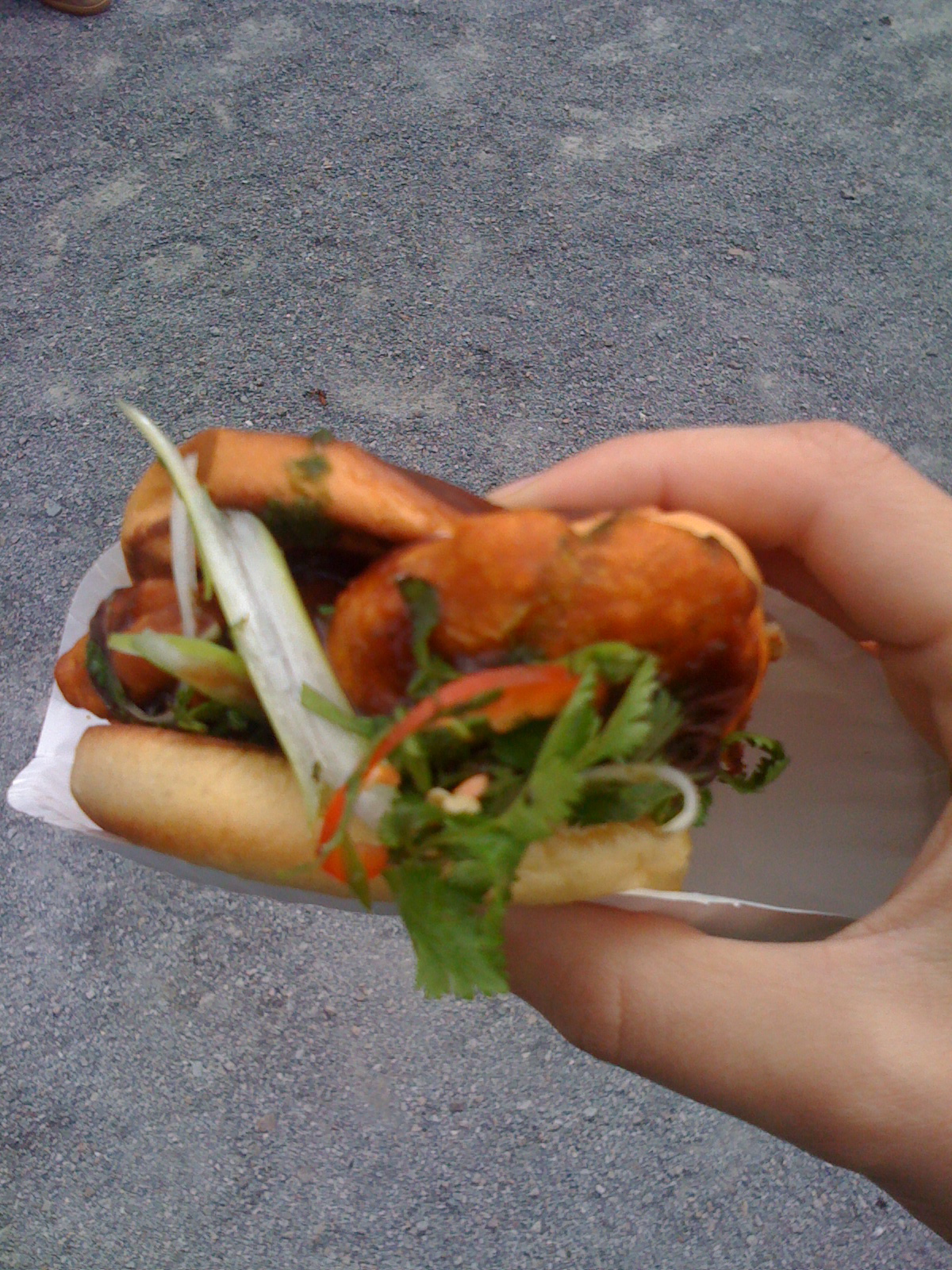
Well I’m an experienced food market strategist. I was waiting for the right vendor when I saw a couple strolling, gobbling sandwiches with cilantro and something fried inside. I caught them mid-bite, asked from whence it came, and was pointed toward Dadar, a stall hawking Bombay street food. The sandwich above is a Vada Pao; for $5 you get to chow down on smashed potato and chickpea flour fried and served on a bun with a tamarind sauce, spicy peppers, and cilantro.

My next diversion was Kombucha Brooklyn’s stand. As some of you know, I am a sucker for kombucha on tap, so couldn’t pass up the opportunity to get a $10 half-growler filled with fresh apricot kombucha. You can refill your buch bottle for $8 at Radish, Urban Rustic, Fresh Fanatic, and Khim’s Millenium, for starters. I told the guy I wanted to work for his company. I was only half kidding. That reminds me, I need to get business cards made. Ok it’s Downton time!