Practices of the unscrupulous money changers stand indicted in the court of public opinion, rejected by the hearts and minds of men.
-Franklin D. Roosevelt, 1933

We can do better: That seems to be the theme of the protests down at Zuccotti Park in New York’s financial district. I went down there on my lunch break today, with the hopes of hearing Naomi Klein speak and to get the lay of the land. Didn’t see Klein, but did stumble upon Keith Olbermann informally speaking with a bunch of protestors and journalists.

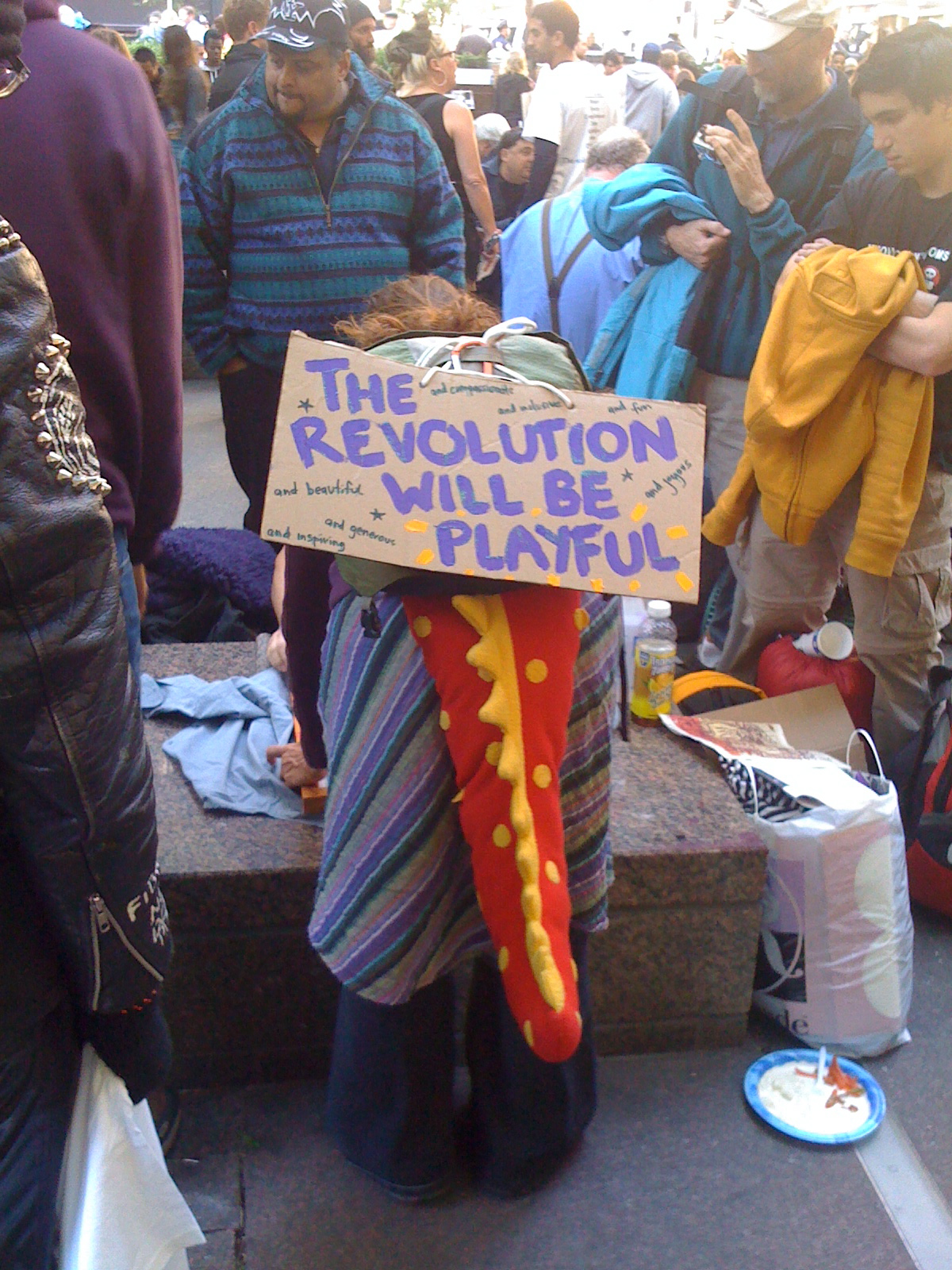
On the day after a march that drew ten to fifteen thousand protestors, as well as endorsements and pledged financial support from big guns like United Steelworkers, MoveOn, the Teamsters, and Democracy for America, the mood of Occupy Wall Street was both festive and solemn, relaxed and serious.

Someone asked Olbermann, who was balancing a slice of donated pizza on a paper plate as he took our questions, if he thought it was ok the movement was still “nebulous” or better to have more specific demands? “A better word than ‘nebulous’ is probably ‘amorphous,'” said Olbermann. “‘Nebulous’ has a negative connotation.” He said every radical movement in history began this way, knowing something is very wrong, and raising a stink before making specific policy demands. Olbermann said he’d have been disheartened if the protest started off so pointed. The gist seems to be that at this stage, inclusion is key.

“What is radical today is status quo tomorrow,” said Olbermann, going on to discuss FDR’s radical reforms in the 1930s during the Great Depression that included Medicare, Medicaid, funding for the public SUNY university system, and social security. I’d add to that list giving the Federal Trade Commission more regulatory power, establishing the FDIC, and establishment of the Works Progress Administration. Those reforms were deemed radical, if not insane, during the Depression, and today are a cornerstone of the United States.

Occupy Wall Street, for all the criticism of it being disorganized, is a fairly well-organized staging site for the protests: Zuccotti Park, normally a sleepy pedestrian plaza where financial workers eat lunch perched on a ledge, is now divided into sections including a Media Center with folks blogging and tweeting on location; an Info section to find out more about the protests; Eating area with volunteers doling out donated food including pizza, granola bars, coffee, soy milk, carrots, nuts, and dried fruit; an area for music, drumming, and mass moments of silence; a daily message board (see below) that lists the weather, events to take place that day related to the protest, world-wide events, tallies of donations, numbers of protestors arrested, etc. It’s more organized chaos than disorganized order.

It’s important to keep pushing the envelope. It is important to keep showing up in Zuccotti Park. It does make a difference. Now I’m just waiting for Obama to come out with a statement in support of the protests. After all, they (we) have got his back, this is a more grassroots (and frankly elegant) way to articulate what he’s been trying to say for two years. Not only should Obama be commenting on the protests here in New York, he should be here. Last night Obama made a statement on the death of Steve Jobs, rest his soul, he can make a statement about fifteen thousand protestors in New York’s financial district.

I never thought I’d be quoting James Hoffa, president of the Teamsters, but here goes:

No one should be surprised that Occupy Wall Street is gaining support and spreading quickly around the country. The American Dream has disappeared for students, whose reality is debt and unemployment. The dream disappeared for workers forced to take wage cuts by employers sitting on billions of dollars in profits. The dream disappeared for working families who paid too steep a price for Wall Street’s greed, stupidity and fraud. It’s clear what this movement is all about. It’s about taking America back from the CEOs and billionaires on Wall Street who have destroyed our nation’s economy. It’s about creating good jobs. It’s about corporate America treating its workers and customers with honesty and fairness and paying its fair share to stimulate the economy.

This year, we had an Arab Spring. Will this be our American Fall?
I had intended to make something from the American Woman’s Cook Book today as promised, a project just waiting for a mellow weekend like this. Alas, I didn’t get around to the chicken pot pie or beef brisket or chess pie just yet. In part I was too busy studying Japanese, getting ready for my new class on Tuesday. Watashi wa Nihon-go benkyoshimashita.

I was in the mood for a roast loin of pork and braised red cabbage, it seemed just the thing to eat on a lazy(ish) Sunday with a chill in the air. If I check I’d probably find such a recipe in my grandma’s old cookbook but I was dashing off to the co-op and in the mood for a little improvising. I remembered last year, around this time, eating such a dish at Dressler, in Williamsburg, and feeling so satisfied. The combination of tender pork with a crispy crust, grainy brown mustard, and acidic-sweet cabbage all in one bite, eaten at Dressler’s lovely, long bar  (one of the best spots to eat at in the city, with or without a dining companion), seemed too good to replicate.

I was lucky to snatch up the last Aberdeen Hill Farm pork tenderloin at the co-op (not a minute later I heard someone page, “Is there anymore pork tenderloin? Pork tenderloin, any more please?”). My plan B, if they didn’t have any, was to try Marlow & Daughters but that would’ve run me a pretty penny. Although, for good quality pork loin, it’s money well spent. I also picked up some Tom Cat Bakery cheddar brioche rolls and served them on small individual plates, just like they do at Dressler, with perfectly softened butter. The loin came out juicy with a crispy exterior, just the way I like it.

Roasted Pork Loin with Braised Red Cabbage

For the Pork:
1 2-lb boneless pork loin
5 garlic cloves, peeled and sliced
1 tbsp fennel seeds
salt and pepper
5-6 branches of sage

For the cabbage:
2-3 tbsp butter
optional: 1 sausage (plain, fennel, or even chorizo is fine), chopped
1 red onion, sliced thin
2 lb red cabbage, sliced
2 tart apples, like Granny Smith, peeled and sliced thin
1 c chicken stock
1/4 c apple cider vinegar
1/2 c orange juice or apple cider
5 or 6 juniper berries
2 cloves
1 bay leaf
1 cinnamon stick
salt and pepper

The day before cooking, if possible, you want to season the meat. First trim off all excess fat from the loin. Slice little gashes into the meat and stick the slivers of garlic inside. Crush the fennel seeds with the side of your knife, or with a mortar and pestle, and rub all over the loin. Cover the meat with a very generous coating of salt, and freshly ground black pepper. Gently push the sage leaves into the meat and tie up with twine, spaced a couple inches apart. Refrigerate overnight. If it’s the day of, that’s fine too, proceed anyway with these steps.

Bring the pork loin to room temperature (about one hour) before cooking. Preheat your oven to 425F. Place the pork loin on a rack over a baking dish, place in the center of the oven, and cook, uncovered until a thermometer reads 130F at the thickest part of the loin. This will take about 40 minutes. Remove from the oven and let the meat rest for 15 minutes, loosely covered with foil.

While the loin is roasting, prepare your braised cabbage. Melt the butter in a dutch oven or stock pot, then add the onions, cooking until softened, about 5 minutes, then add the sausage, cooking on medium heat for a few minutes. Add the cabbage and apples to the pot, stir, and let cook down for 8-10 minutes. Then add the chicken stock, apple cider vinegar, and juice/cider. Turn the heat to high.

Place the juniper berries, cloves, bay leaf, and cinnamon stick in some cheesecloth, and tie up. Toss into the cabbage pot, along with salt and pepper, to taste. Once the liquid is boiling turning the heat down to low, cover, and let cook for 20-25 more minutes.

Slice the loin against the grain and serve with dollops of the brown mustard and of course, the braised cabbage.

Fall officially began last Friday, and October begins today. So along with trading my floppy moccasins for leather boots, I’m trading my summer ice cream fetish for hot chocolate. During the warm months I have a thing for ice cream—it’s hard for me to walk by a yellow Van Leeuwen truck or any gelataria without sampling the goods. And then as soon as the weather turns cool all of a sudden I have no problem passing up a cone of mint chocolate chip or a cup of black sesame, say. But I just trade one habit for another.

Now I have to avoid the stretch of 18th Street between 5th and 6th Avenues to avoid City Bakery lest I indulge in a daily splurge of their famous liquid chocolate (yes it’s made from melted chocolate bars). Luckily I no longer work near either of Jacques Torres‘s locations in Dumbo or West SoHo so that settles that.

Well a hot chocolate habit can get pretty expensive—at nearly $5 a pop at Pain Quotidien (a stone’s throw from my office) and $3 at Pret (also within stone-throwing distance) it was time I got creative and got in the kitchen. I don’t generally buy milk anymore. I just didn’t have that many uses for it. Lately I rotate among three alternatives: rice, soy, and almond. I like them all for different reasons. Rice is great with cereal or on its own; soy is best as a substitution in recipes and sauces in place of milk; and almond is when you want something lighter.

So last week, on the first day of fall in fact, I found myself at home wanting hot chocolate but unwilling to venture out into the pouring rain to get some. I had almond milk in the fridge so started by warming up a cup in a small saucepan on the stove. Now all I needed was the chocolate and the sweetener, both of which could take multiple forms. I have Fox’s U-Bet syrup in the fridge for making classic egg creams but that seemed too cloying for the occasion. I had a bar of dark chocolate but was saving that to eat on its own. So instead I opted for the cocoa powder in my cupboard. As for adding sweetness, I passed up the agave, white sugar, brown sugar, cane sugar, and honey in favor of…you guessed it folks…Vermont Grade B maple syrup. You might recall my post back in the spring for Vermont iced coffee sweetened with the stuff.

I added less than a tablespoon but more than teaspoon of the cocoa powder to the almond milk heating in the saucepan, and a small spoonful of maple syrup. I heated it up for about 5 minutes until hot but not boiling then served in a big ‘ol mug. So there you have it folks: vegan hot chocolate. That was not my intention per se but it was delicious, chocolatey, and not too sweet at all, just the way I like it. It went down as smooth as ice cream.

Hot Chocolate
serves 1

1 c (8 oz) almond milk – could also use soy, rice, or cow
1/2 tbsp cocoa powder – can use more or less to taste
1/2-1 tbsp maple syrup – again, can adjust to taste
tiniest pinch of salt

Put the milk in a small saucepan and turn the heat on low. Add the cocoa powder and maple syrup, stir, and heat up for a few minutes until hot but not boiling. Serve on its own, with whipped cream, or a tiny pinch of cayenne to spice it up.

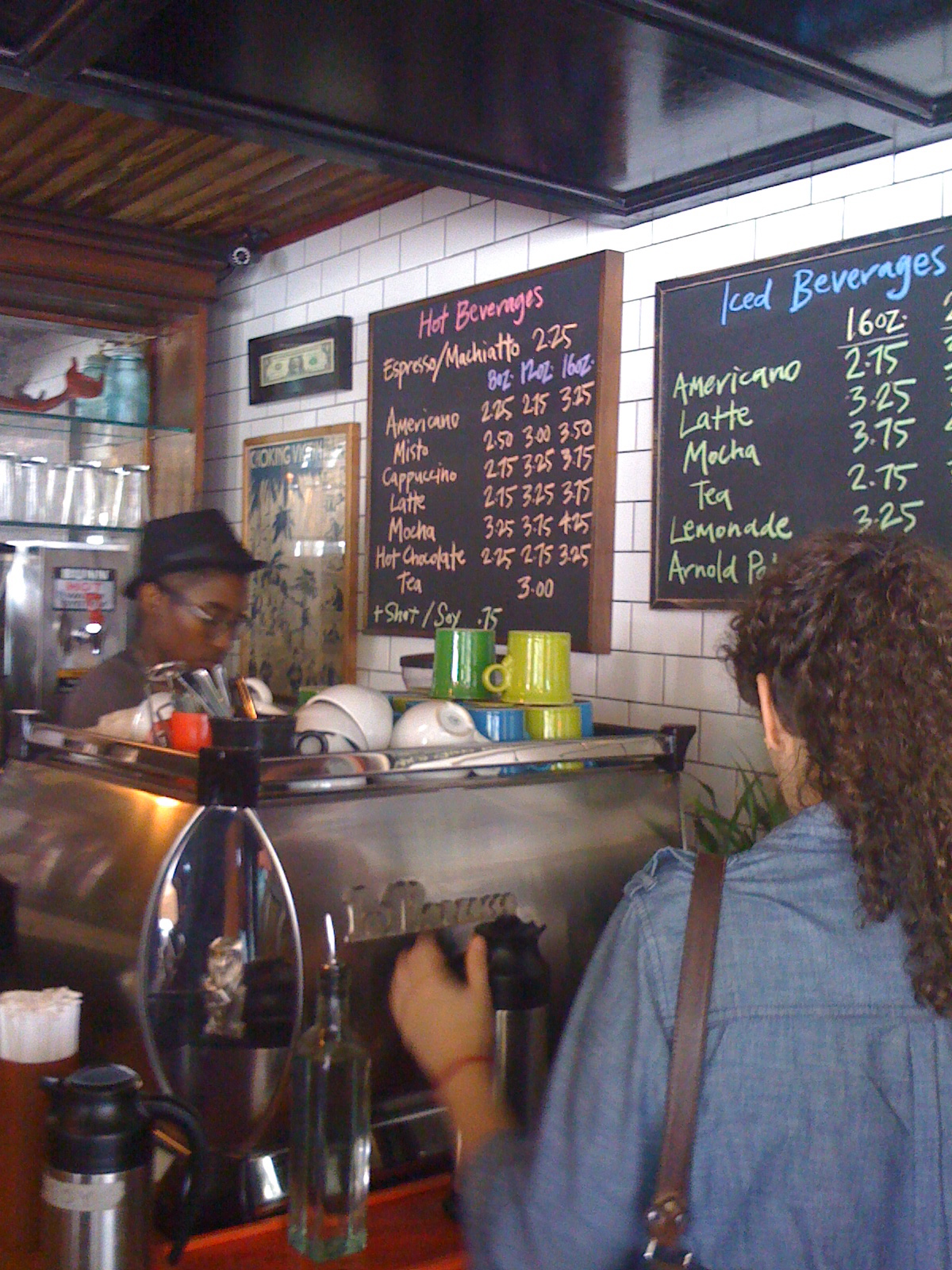
Now the photo up top is not in fact from a hot chocolate quest, but is from this morning’s field trip with a few new friends in my neighborhood. This is Bedford Hill Coffee Bar, on Franklin Ave. in Bed-Stuy, home of delicious americanos and pastries. And below, well that would have to be Dough now wouldn’t it? Just up the street from Bedford Hill, Dough makes delectable yeast donuts with wacky flavors like passionfruit with cacao nibs, dulce de leche with toasted almonds, and a bright pink hibiscus donut. Today I opted for passionfruit.