I’ve been having a ball in my home-away-from-home state of Vermont. I drove up last Friday with my sister Emily and her dog, Julius. I’ve swam almost every day in Lake Champlain or Goshen Dam, avoided stepping on zebra mussels, eaten sweet and drippy peaches, visited the Middlebury food co-op (3x), walked around the Middlebury College campus with Arianna and Rafa, read and napped in a hammock, eaten maple cremees, accompanied friends on a blueberry-wine tasting, and tonight might go to the drive-in. I love summer!


I’m usually in Vermont this week every year, and in this post and this post from last July 4th I blogged about living the good life in Vermont too. In fact, I think I’ll make that cashew spread again. Why am I returning to Brooklyn tomorrow?

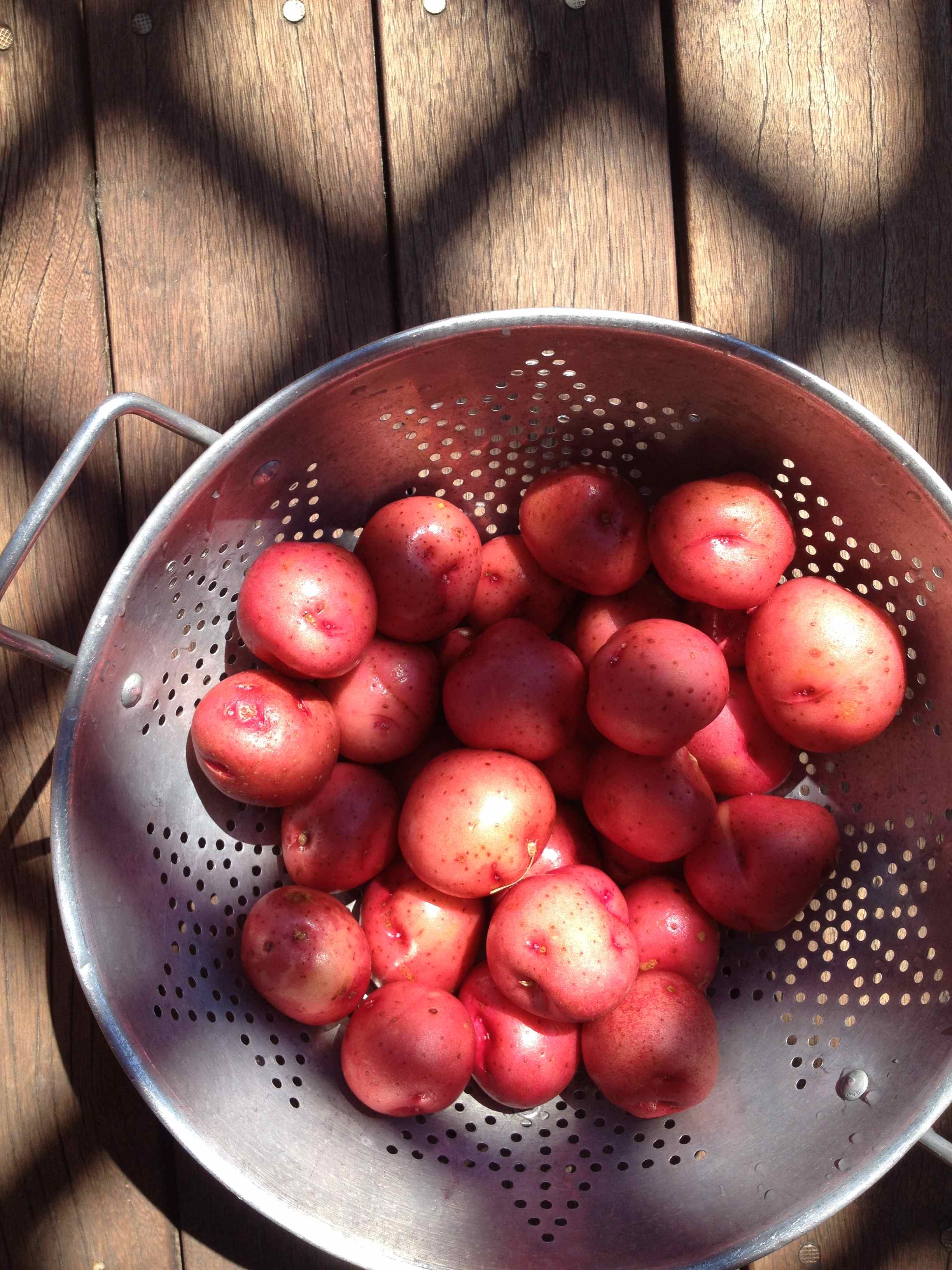
Before arriving last week I told my stepmom Bonnie that I wanted to make a French potato and green bean salad, like the one David Tanis wrote about recently in the New York Times. Think of it like an improved upon summer potato salad, with a mustardy vinaigrette instead of mayo, tossed with green beans, olives, and lots of fresh herbs. I made it Vermont-style, meaning, whatever Bonnie had in the garden and local eggs. From the garden I picked chives, purple and green basil, thyme, and flat-leaf parsley. I wish I’d remembered to toss in the remaining scapes we had, but used garlic instead. This salad can be prepared ahead and served room temp or cold, perfect for a summer picnic or barbecue.

Vermont Potato and Green Bean Salad

1 3/4 lb small red potatoes
Salt and pepper
1 bay leaf
1 large thyme sprig
1-3 garlic cloves, mashed to a paste, to taste
1 tbsp anchovy paste
1 tbsp chopped capers
2 tsp Dijon mustard
4 tbsp white wine vinegar
1/3 cup extra virgin olive oil
1 pound small French beans, or green beans
4 large eggs
Handful of chopped herbs: chives, parsley, basil
1/4 cup pitted, cured black olives

1. Bring a large pot of salted water to boil. Add the potatoes, a bay leaf, and the thyme. Simmer for about 20 minutes until the potatoes are still firm but can be pierced easily with a fork. Remove from the water with a slotted spoon and cool. Don’t drain the water because you can use this later for the green beans.

2. Make the vinaigrette: In a bowl combine the garlic, anchovy paste, capers, mustard, and vinegar. Whisk in the olive oil, and season with salt and pepper.

3. When the potatoes are cool, cut into thick slices. Season with salt and pepper, and cover with half the vinaigrette. Set aside.

4. Trim the ends of the beans and simmer in salted water for 3-4 minutes. Drain and cool under running water.

5. Cook the eggs: bring a pot of water to boil. Add the eggs gently and cook for about 8 minutes, 9 for a firmer yolk. Crack and peel immediately to cool. Cut each egg in half and season with salt and pepper.

6. When ready to serve, coat the green beans with the remaining dressing, and add to the potatoes. Arrange the eggs and olives on top. Garnish with the fresh herbs and serve.
Below are shots of the purple basil in the garden; ice cream from Middlebury; and I just had to have a picture with this teal green bug in town. There was a summer in California I drove around in a bright yellow one, I’ll see if I can find a photo of that. Happy 4th people.

This post comes to you from the Bahamas, where I’m visiting friends for the week, via my friend Daurie in Mexico.

Daurie and I met years ago as high school students in Vermont; it’s a cliche to say we became fast friends, but, well, we did. I would sleep over her house on school nights so we could get up at six in the morning to go for four-mile runs out past her father’s deer farm. For my sixteenth birthday she threw me a surprise party—I can remember about ten of us staying up the whole night in the woods behind her house, in thick snow, playing under the moonlight. She is also the first person I cooked spinach with; the recipe called for something like “a whole bunch” and that just seemed absurd, so we used only about 1 cup. To our disbelief, after cooking we were left with about two bites of sautéed spinach.

Nowadays Daurie teaches at the Centro Cultural de Lenguas, a language school in downtown Morelia, in Michoacán, Mexico. As a very cool assignment, she had her intensive students write a traditional Mexican recipe in English, with a small paragraph introducing the dish. Then I would select the best one and publish the winning recipe here on Mostly Food.

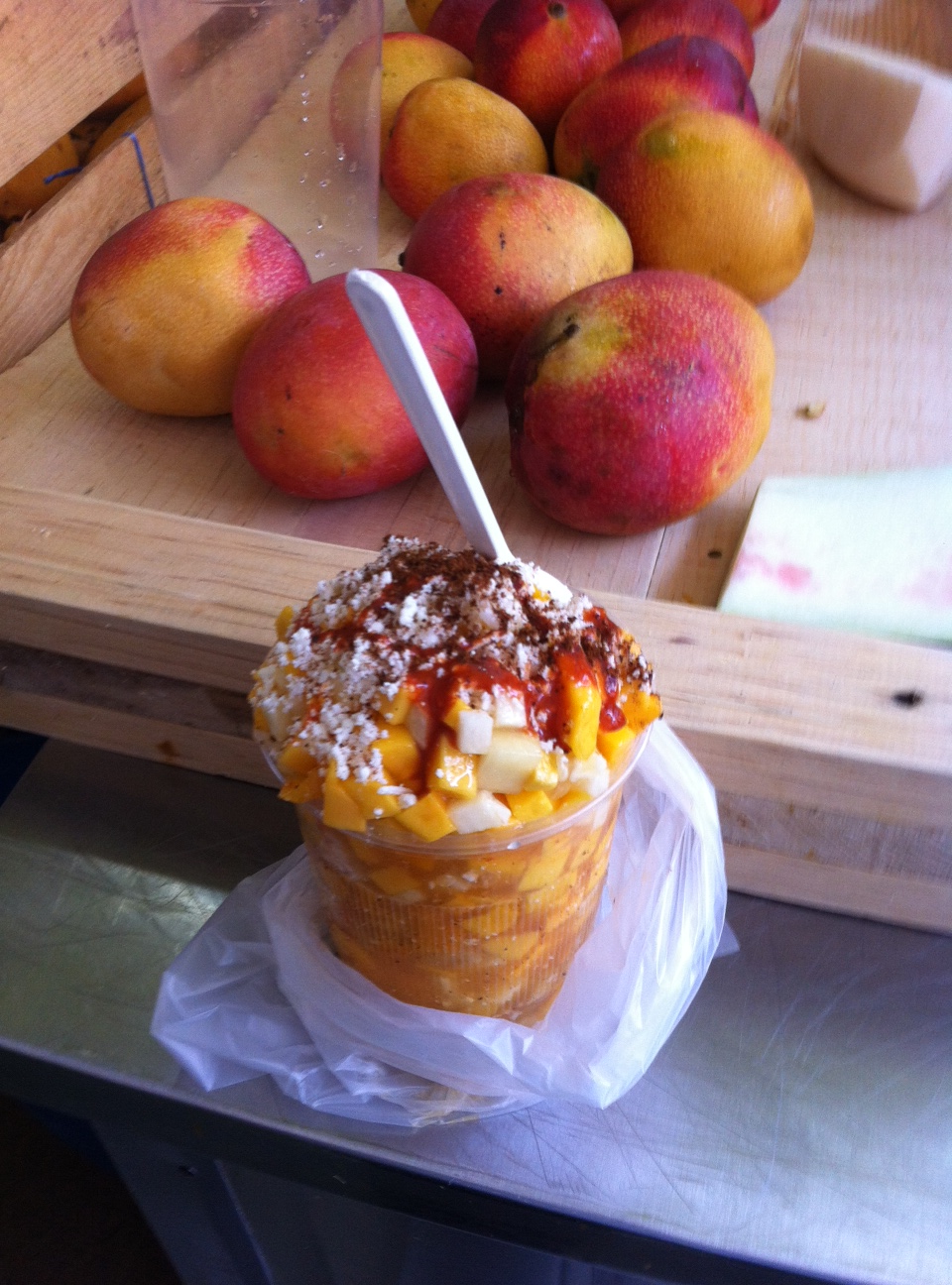
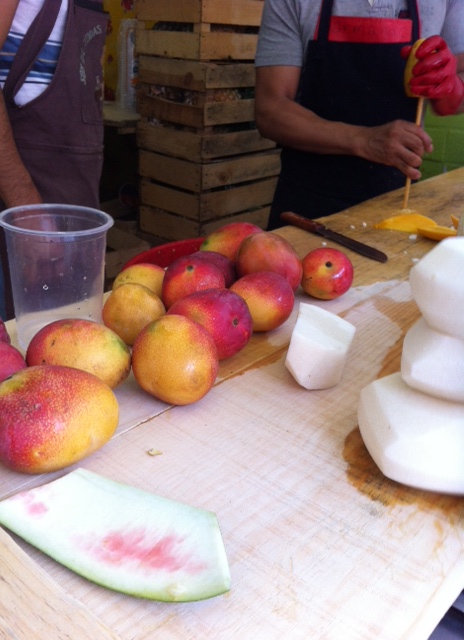
It was difficult choosing a winner. All the recipes—from chilaquiles to stuffed poblano peppers—were charming, funny, well written. In the end, I selected the gazpacho, in part because as summer rolls around, this would make for a refreshing bite—and I like the part about Gaspar and his missing teeth. As you’ll see it’s different than Spanish gazpacho, which is a cold soup mainly of pureed tomatoes. This version is fruit based: pineapple, mango, jicama and fresh orange juice, and comes to us courtesy of Omar, Vicente, and Alfredo (pictured in the bottom photo).

Mexican Gazpacho

One time in a fruit store, when the fruit was chopped in big pieces, an old man came to buy fruit. However, he had a problem with his teeth because he only had a few them. Then the old man asked the owner of the place for a favor. He said, “Please chop the fruit in little pieces, because I can’t eat it in big pieces.” So the man chopped the fruit and put it in a glass with some orange juice. That’s how the old man always came back to buy the same fruit. One time the man asked his name. It was Gaspar and for that reason the name is Gazpacho.

Preparation time: 20 min.
Servings: 7

Ingredients:
1 Pineapple
5 Mangos
2 Jicamas
1 Liter Orange juice
1 Cup. Grated cheese
2 Limes
1/2 Tsp. Salt
Chile piquin to taste
Valentina salsa to taste

Preparation
1. Wash the fruit.
2. Peel the fruit and cut into small pieces.
3. Put the ingredients in a bowl and mix.
4. Add the orange juice.
5. Cut the 2 limes in half and squeeze the juice on the mix.
6. Add grated cheese, salt, chile piquin and valentina salsa to taste.
7. It’s ready to enjoy.

I’m the first to admit I’m a little late to the strawberry rhubarb party this year. It’s not my fault! My day job has turned into a day-and-night job leaving little time to tend to matters of the kitchen. Take heart, yesterday morning I woke up with my priorities straight. I ran (literally) to the Fort Greene farmer’s market (site of the fiddlehead fiasco a few weeks ago) to fetch strawberries so small and sweet they resembled raspberries and tasted like jam. And I was delighted to see the rhubarb still hanging around, weeks after I first saw it (and rushed by it) at the Union Square Greenmarket.

But what’s that I see? Cherries?! I haven’t even tasted my first bite of a strawberry-rhubarb crisp this season and already there are cherries to contend with? Maybe next week. Yesterday I was on a mission and would not get distracted, no matter how sweet the cherries looked.

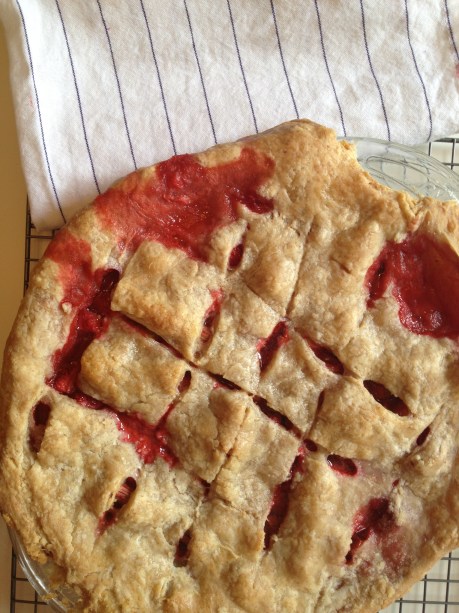
I was after the classic strawberry rhubarb pie. A fool’s mission, you may think, given the tendency for strawberries to explode mid-baking, making for a runny mess for your crust to sop up. So call me a fool. I love this particular pie. I love it in June (I love June period). I love it with ice cream or without. I love it standing up in a Brooklyn kitchen late at night or in a backyard in Vermont. And most importantly, so does my grandmother, and I wanted her to have a big ole piece of it.

I thought about fussing of course. I picked up and smelled the herbs at the market, wondering at first how sage would go with these flavors, then thyme, then mint. And then wondered about balsamic vinegar and black pepper, before deciding to keep it simple. Well, mostly simple.

The only two additions I allowed were freshly grated ginger and lemon zest, just to spice things up a bit without going completely rogue. I love the combination of rhubarb and ginger, and that of strawberry and lemon. The proof was in the filling: when baked this pie was not too sweet, but lusciously fruity, jammy, June-y, tart, with just a hint of the lemon and ginger to elevate the senses.

And fear not—the pie crust took all of five, maybe eight, minutes to make, and no food processor or pulsing required. I’d been wanting to try Cook’s Illustrated recipe using vodka in place of the water. The theory is that vodka, in large part pure alcohol, provides the necessary liquid to bind the dough, then cleverly evaporates during baking to yield a flakier crust. I proceeded cautiously and used only 1/4 c of ice-cold vodka (left over in my freezer from New Year’s), mixed with 1/2 c water. And you know what, the crust was buttery and flaky and darn tasty.

Next week: cherries anyone? And good luck to Rafa at the French Open this morning, I would love to see him put an end to Djoki’s streak. Only two months til the US Open!

Strawberry Rhubarb Pie

For the crust:
2 1/2 c flour (I like 2 c all-purpose and 1/2 c whole wheat pastry flour)
1 tbsp sugar
1 tsp salt
2 sticks cold, unsalted butter (16 tbsp), cut into small cubes
1/2 c cold water
1/4 c cold vodka

Combine the water and vodka, add an ice cube or two, and set aside. Mix the flour, sugar, and salt in a large bowl. Add the butter and work quickly (with a pastry blender, whisk, or your hands) to combine until pea-sized crumbs form. Add 1/2 c of the liquid and continue mixing. You can add the rest if and when you need it, which you probably will. Separate the dough into equal halves, flattening a bit and transferring to plastic wrap. Refrigerate for a minimum of an hour and up to one week.

For the filling:
1 1/4 lb rhubarb, cut into small pieces
1 lb strawberries, hulled and halved
1/2 c cane or white sugar
1/4 c light brown sugar
dash of salt
zest from 1/2 lemon
1 tbsp lemon juice
1 tsp fresh grated ginger
1/4 c corn starch
Optional: 1 egg yolk mixed with a little water for glaze

Preheat the oven to 400 F. Prepare to roll out the dough by cleaning a large surface and flouring it. I like to roll out dough directly on a large piece of saran wrap. Roll half of the dough into a roughly 12- or 13-inch diameter. Carefully transfer to a 9-inch pie dish and set aside.

In a large bowl combine the rhubarb, strawberries, sugars, salt, zest, lemon juice, ginger, and corn starch. Transfer the filling into the pie crust. Roll out the second half of the pie dough, this time to a slightly smaller diameter. Transfer over top of the filling, pressing around the sides to remove any gaps. Trim the ends of the pie and crimp the edges. Make decorative slits to let steam escape. Brush the top with the egg yolk mixture.

Place on a baking sheet and transfer to the oven, baking at 400 for 20 minutes, then turn the temperature down to 350 for an additional 20-25 minutes, until the crust is golden brown. Transfer to a wire rack to cool and let cool completely (if you can resist) before digging in.