Archives for posts with tag: vegetarian

I am the first to admit that I am somewhat of a whimp when it comes to cold weather. Not like LA whimpy where you pull out a puffy down coat around the 60-degree mark (I did live in Vermont and Ithaca after all), but this time of year I do start to wonder when the heat will come on in my apartment, how long I can stay in the shower each morning, and what’s an acceptable number of hot beverages to consume before noon. My eating habits change quite a bit too. I trade in the green smoothies and raw salads for warmer, more comforting fare. And this soup is no exception.

This is one of the simplest soups to make. Not quite as easy as the avocado soup I made this summer, but not as time-consuming as this black bean soup I made back in January. It makes good use of the beautiful late-harvest squash at farmer’s markets this time of year and provides just the right amount of warmth and spice to help you ease into fall.

The secret weapon of this soup is the roasting. Not just roasting the squash—which adds more flavor and richness than sautéing—but you’re roasting an onion and whole small head of garlic that also gets puréed into the mix. Shazam! This soup gets its bright color not only from the butternut squash but the turmeric that’s in the curry powder or garam masala. The coconut milk adds a luscious richness and depth, and the red chile pepper flakes kick the heat factor up a notch. Oh, and don’t discard those squash seeds! Toast them on the baking sheet with the squash for about fifteen minutes and then serve with the soup, if there are any left after you snack on them warm from the oven. Key word: warm.

Coconut Curry Butternut Squash Soup
Serves 4

1 large butternut squash, or 2 small
1 small head of garlic
1 onion, any variety
Olive oil, for drizzling
1/2 c unsweetened light coconut milk
1 1/2 c vegetable stock
3/4 tbsp curry powder
Red chile pepper flakes
Salt
Pepper

1. Preheat the oven to 400 F. Cut the squash into quarters, discarding the stringy bits in the center and setting the seeds aside. Place the squash, flesh side up, on a baking sheet. No need to peel. Place the garlic, skin and all, on a small piece of tin foil and drizzle with olive oil, and then wrap the garlic entirely in the foil. Place on the baking sheet. Slice the onion in half and add to the baking sheet as well. Drizzle the squash and onion with oil, salt, and pepper, and place in the oven for 50 minutes to an hour. You may need to remove the onion earlier than the squash.

2. While the vegetables are roasting, rinse the seeds and pat dry. About fifteen minutes before pulling the vegetables out of the oven, place the seeds on the baking sheet. They will roast and turn brown. Remove before they get too dark, about 15 minutes.

3. Remove the vegetables and seeds from the oven and let cool. When cool enough to handle, transfer the flesh of the squash to a blender or food processor, along with the onion and the roasted cloves of garlic. You should be able to just pinch the roasted garlic from its skin. Blend until smooth, adding a little bit of broth if needed.

4. Transfer the purée mixture to a large pot on the stove, stirring in the coconut milk and rest of the broth. Let simmer on medium-high heat for 10-15 minutes, adding the spices and seasoning to taste. Serve with the toasted seeds, and, if you’d like, a dollop of crème fraîche. I also served with a salad of green Boston lettuce, pears, walnuts, sliced grapes, and an olive oil-tahini dressing. If I had blue cheese, that would’ve been in the salad too.

Yesterday the rains came. But in a very springy, misty, pleasant kind of way, where the light outside is still bright. I was hard at work but something about the sight and sound and smells propelled me into my kitchen.

Having been away this weekend where I wasn’t able to do any cooking, or healthy eating for that matter, I came home craving my kitchen, my food—greens, grains, avocados, spice. I’ve also been doing a spring cleaning of sorts, drinking gingery-spicy fresh juices, eating mostly vegetarian, and back on Chinese herbs for my allergies. (But don’t worry, I throw in the occasional pork taco or tiramisu for good measure.)

Recently, I started skimming Eat Right For Your Type, written by naturopathic doctor Peter D’Adamo. As a B positive, I’m advised to eat venison, rabbit, goat, and mutton for my protein, and avoid chicken as it contains a blood type B agglutinating lectin. Also on the avoid list for B’s: sesame seeds, peanuts, corn, tomatoes, lentils, buckwheat, and wheat. I’m not sure how much stock I put into this but would be curious to try it at some point and see how it affects my blood sugar levels and energy.

Blood type B’s are somewhat uncommon among white U.S.’ers and Europeans, and today are mostly clustered in India, northern China, and Korea. The blood type originated in the cold climates of the Himalayan mountain region and may have mutated from blood type A in eastern Africa as a response to climatic change many, many centuries ago.

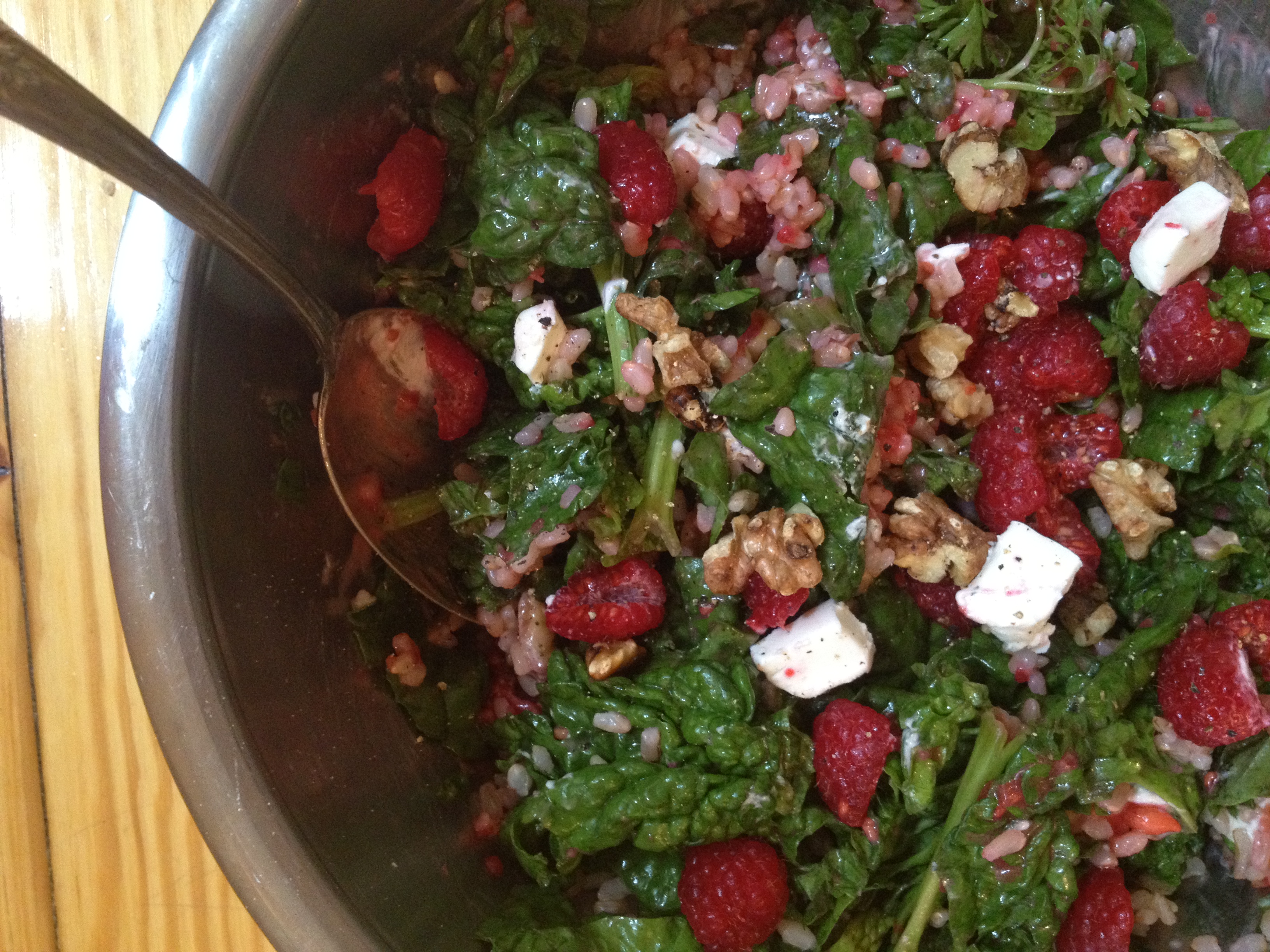
Back to lunch…So I’m grappling with some big work deadlines, and this usually means lunch on the go, or no lunch at all. But yesterday I spent a bit of time getting reacquainted with my kitchen by making this rice salad. It’s basically brown rice that’s mixed with raw spinach (which wilts when combined with the warm rice), toasted walnuts, basil, and goat cheese with a homemade raspberry vinaigrette.

You could do any number of variations on this (channeling Mark Bittman)—wild rice instead of brown; arugula or lamb’s quarters in place of spinach; toasted pecans or hazelnuts instead of walnuts; blue cheese or shaved parmesan instead of goat; and a lemon or balsamic dressing in place of raspberry. I also think tempeh could be a fine addition and boost the protein if you’re so inclined. So could mutton, of course.

This salad is light and springy, perfect for lunch, and as far as I know, approved for us B’s.

Rice Salad with Raspberry Vinaigrette

2 c cooked rice (about 1 c dry rice)
Bunch of spinach, cleaned and trimmed
1/2 c toasted walnuts
1 c raspberries
1/2 c olive oil
Splash red wine vinegar
Fresh lemon juice
Handful of basil, roughly chopped
4 oz. soft goat cheese, crumbled
salt and pepper, to taste

When the rice is finished cooking, transfer to a large bowl and add the spinach, to wilt, and the toasted walnuts.

In a blender or food processor, combine 1/2 c of the raspberries, the olive oil, vinegar, a squeeze of fresh lemon juice, and some salt and pepper, and blend until smooth. Add the desired amount (I used all of it) to the rice mixture and stir will. Before serving add the basil, goat cheese, and remaining raspberries, cut in halves, and salt and pepper to taste.

Photo below from my dining room window, courtesy Instagram, of yesterday’s springy rain. Oh, and Remedy was featured this weekend in the New York Times T magazine in a piece about up-and-coming “foodieodicals!”

Step away from the matzo. That’s what I keep telling myself during Passover when matzos appear everywhere from Jacques Torres to each seder table in town—whether that’s your feminist seder on the Upper West Side, queer seder in Park Slope, conceptual non-seder in Bushwick, or Bubbe’s in Brighton Beach. When you walk into the coop you’re bombarded by towers of them. I used to eat matzo with my grandmother (still do), buttered and sprinkled with salt, and we decided recently our favorite is Yehuda, for its black char, like good brick-oven pizza. But never had I made matzo ball soup before yesterday.

Passover is bittersweet—it commemorates the story of Exodus, marking the Jews’ freedom from slavery in Egypt. They fled through the desert, leaving no time for bread to rise, and thus the tradition of avoiding leavened bread for the eight days. In order to avenge the Jews’ enslavement, ten plagues are said to have been put upon the Egyptians, including the murder of their first-born sons. As a kid, and to this day really, it was hard to get past the imagery of lamb’s blood and children dying, but that’s actually part of the commemoration—the acknowledgement of suffering as well as the joy of freedom.

I was raised Catholic, but my siblings and I are actually part Jewish, although I’m just about the only person in my family to identify that way. My mother’s father was Jewish (his mom’s last name was Levy), but I’m named after my father’s family, Catholics from the Normandy coast in France. It’s not difficult to understand why my grandparents and great-grandparents wanted to disavow their Jewish heritage during World War II—even in Flatbush, Brooklyn—but it does kind of break my heart that that part of our identity got lost.

I wasn’t able to attend a seder for Passover this year but was eager to eat matzo ball soup (and brisket, but that’s another post), and therefore took it upon myself to forge ahead and DIM (do it myself).

So one day last week I put on some Prince and started looking up recipes. In good Jewish fashion there’s lots of arguing and kvetching about what to do and not to do, whether to make your matzos light as air or heavy as lead, whether to use seltzer or not. I combined a few recipes to create my own version and prepared to make this vegetarian take on Jewish dumpling soup while at my grandmother’s yesterday.

On an unrelated note, I find it sort of depressing listening to the song “1999” now. When it was written twenty years ago the millennium sounded so cool and futuristic and now it’s ancient history. “I Wanna Be Your Lover,” on the other hand, timeless. I mean, c’mon “I wanna be your lover, and your mother and your sister, too…”

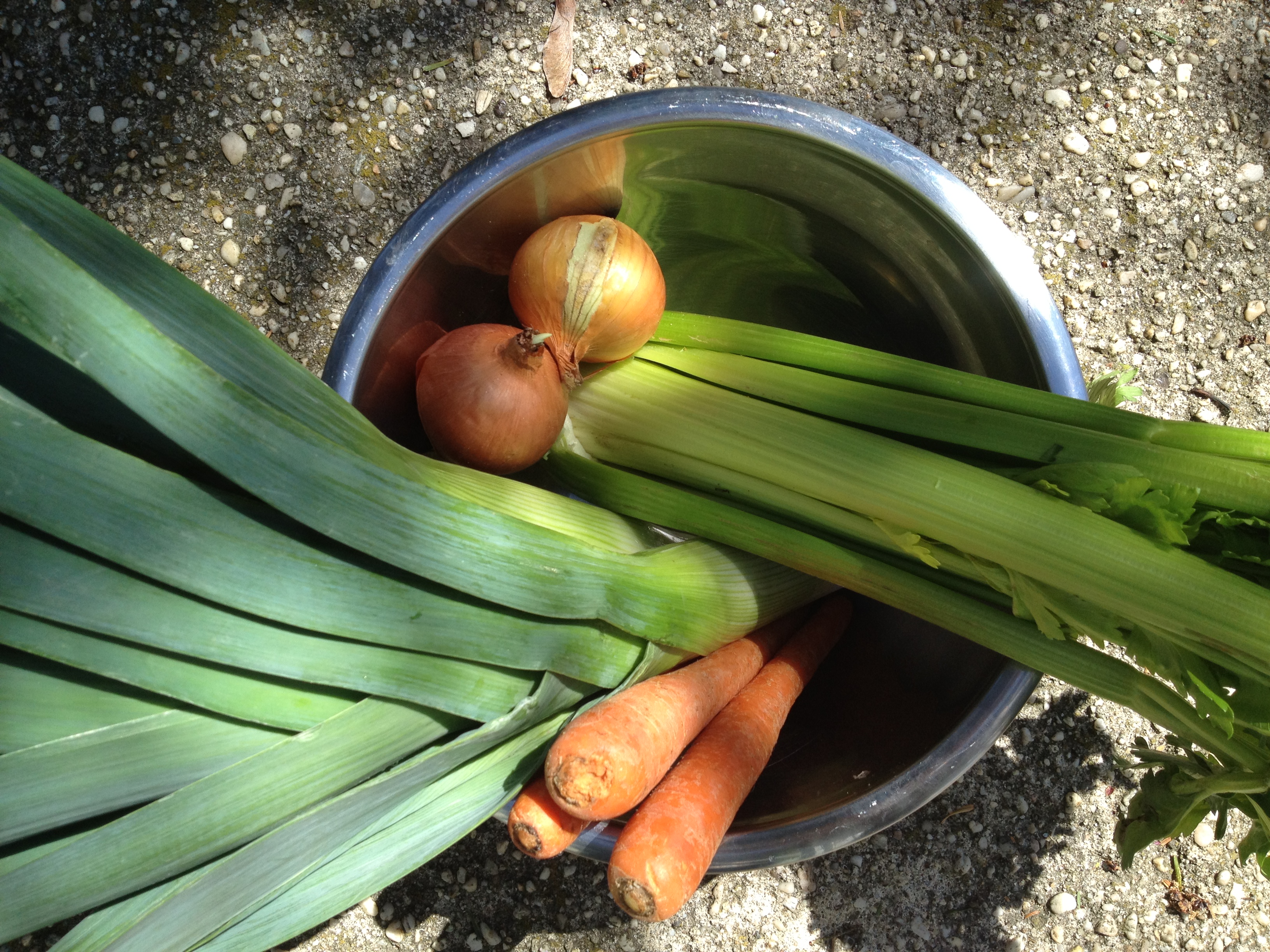
Anyway, you start with the stock. It goes without saying that traditionally matzo soup is made with kosher chicken stock. But I didn’t feel like schlepping a four-pound bird back to my apartment only to boil the crap out of it for broth, and besides I didn’t know who might be eating my soup. Also, yes, been eating less meat. But still, other than the matzo balls there’s really just broth so it’s important to attend to this aspect of this dish. I bought leeks, carrots, onions, garlic, and celery and sauteed these in butter and olive oil in my stock pot. To that I added two quarts of water and a spice sack I rigged out of a tea bag because I forgot my little cloth spice sack—tea emptied, and bag filled with black peppercorns, juniper berries, mustard seeds, coriander seeds, and fennel seeds, then tied in a knot. I was cooking in my grandmother’s tiny kitchen that hasn’t changed since 1955 (we’re gonna party like it’s…) and I know the drill: I bring all my own knives, cutting boards, cheese graters, salt, pepper, olive oil, pots and skillets when I cook out there. She just laughs when I barge through the door like I’ve just robbed a Williams Sonoma.

While your stock is simmering you can quickly put together the matzo dough. Then let it chill in the fridge for at least an hour while you go play tennis and maybe pick up a dessert.

My matzo dough came out a little darker and chunkier than I expected, but I think that’s because a) see point above about the char on Yehuda matzos and b) I didn’t quite grind the matzos into as fine a breadcrumb as perhaps I should’ve. No matter, these were still really flavorful, light, and buoyant. And the stock practically tasted like I had in fact boiled a whole chicken in there—it was light and rich at the same time, well seasoned and a nice accompaniment to the matzos, which I served two to a bowl with sprigs of fresh dill for some springtime green.

It got a little steamy here…

Matzo Ball Soup [for heathens and devotees]

For the matzo balls:
6 matzos, pulsed in food processor to a fine crumb
1/4 tsp baking soda
1 tsp salt
4 eggs
2 tbsp melted butter
1/3 c seltzer water

For the stock:
2 tbsp butter
1 tbsp olive oil
1 large onion, diced
2 carrots, sliced in thin rounds
2 celery ribs, sliced
2 leeks, green tops discarded, whites cleaned thoroughly and chopped
3 cloves of garlic, chopped
spice sack: some combination of black peppercorns, juniper berries, coriander seeds, mustard seeds, etc.
1-2 bay leaves
salt
Fresh dill for garnish

Get the matzo balls going: in a medium bowl combine the dry ingredients. In a separate bowl, mix the wet ingredients, then add to the dry mixture, combining but not over mixing. Chill in the fridge for at least one hour (more is fine).

While the matzo balls are hanging out in the fridge, start your stock: add the butter and oil to your stock pot and heat on medium. Add the diced onion, carrots, celery, leeks, and garlic, and wilt for about ten minutes. Then add about 2 quarts of water (you can also use vegetarian stock but I didn’t) and bring to a boil. Toss in your spice sack, bay leaf, and salt to taste. Simmer the stock on medium heat with a lid slightly ajar for about one hour.

Bring a separate pot of salted water to boil. After the matzo has chilled, wet your hands a little bit to make handling easier. Roll the dough into small rounds about the size of golf balls (they expand when you cook so don’t make too big!). Turn the stove down a little so water is gently, rather than rapidly, boiling, and carefully add matzo balls to the pot. Cover with a lid and don’t lift the lid for 25 minutes or a curse will be placed on your first-born child. After 25 mins. check to make sure they’re done and if so turn off the water and remove with a slotted spoon and add to the veggie stock and let them get hot in there for about 15 minutes so they absorb the flavorful stock. Serve with fresh dill.

I roasted this asparagus as well, finished off with lemon juice, parmesan, and slices of garlic that I cooked in a separate skillet in a little bit of olive oil. Mm hm.