IMG_3772

It’s no secret: I am possibly cooking my way through the entirety of Yotam Ottolenghi’s cookbook Jerusalem. I’ve blogged about a couple of the recipes here—Lentils with Broiled Eggplant and Preserved Lemons; and from his earlier book Plenty, Hummus & Ful, Caramelized Garlic Tart. This month’s Recipe Lab at the New York Times is even focusing on Jerusalem and soliciting fan favorites. I’ve been meaning to write in.

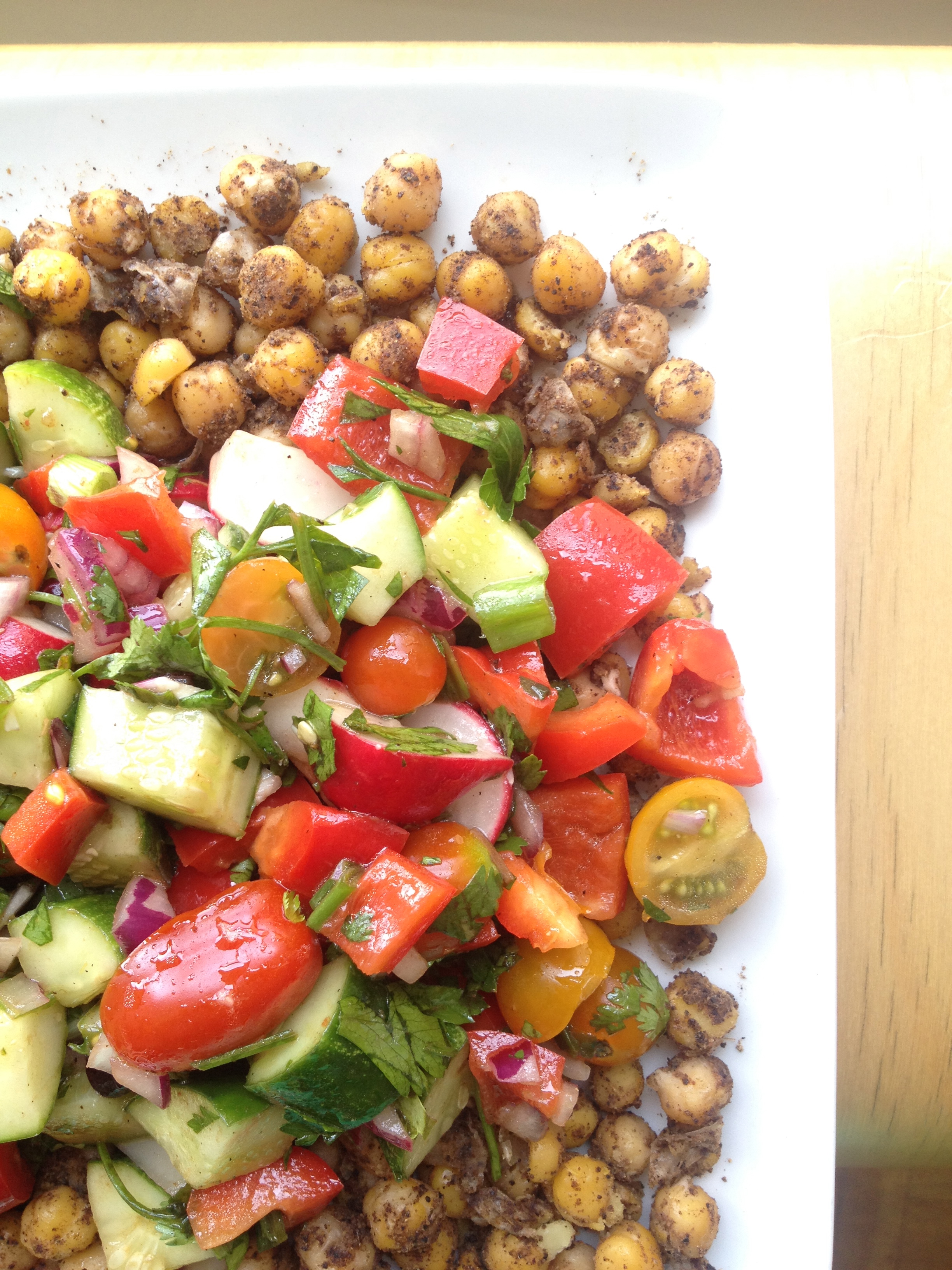
I was flipping through Jerusalem the other day before shopping at the food co-op. I had almost settled on the Helbeh—a honey-soaked, fenugreek-infused cake—when I remembered the outside temperature (97 F) and how much I have been avoiding the oven. I stumbled next on a recipe for Spiced Chickpeas and Fresh Vegetable Salad, a gorgeous mélange of crisp vegetables that are all currently in season, accompanied by chickpeas coated in spices then quickly fried in olive oil. Served with greek yogurt it seemed like the only other thing I’d like to eat in this heat other than cold watermelon. (Check out Bittman’s Watermelon All Day Long in this weekend’s Times’ Magazine.)

IMG_3755

You need to get a head start on this the night before by soaking 1/2 cup chickpeas in cold water with a pinch of baking soda. The next day, as the chickpeas are cooking, you can assemble the rest of the salad. I improvised and bought what looked best at both the co-op and the farmer’s market—crunch Kirby cucumbers, local radishes, an assortment of cherry tomatoes from Hepworth Farms, purple scallions, cilantro, and parsley. It’s that time of year in the Northeast when you can’t really go wrong in the produce department if you stick to buying locally.

IMG_3761

I’d love to serve the salad as brunch for friends, along with some good pita and homemade hummus. To the salad you could add a salty cheese like feta; or maybe even watermelon!

Spiced Chickpeas and Summer Vegetable Salad

1/2 c dried chickpeas
1 tsp baking soda
2 small cucumbers
2 medium or large tomatoes, or a small basket of cherry tomatoes
1/2 pound of radishes
1 red pepper, seeded, with white pith removed
1 small or 1/2 large red onion, peeled
1/2 cup scallions (green or purple), chopped
1/2 cup cilantro leaves and stems, coarsely chopped
1/2 cup flat-leaf parsley, coarsely chopped
6 tbsp olive oil
grated zest of 1 lemon, plus 2 tbsp lemon juice
1 1/2 tbsp vinegar (such as sherry, champagne, or combo white and balsmic)
1 clove garlic, chopped
1 tsp sugar
1 tsp ground cardamom
1 1/2 tsp ground allspice
1 tsp ground cumin
Yogurt (optional)
salt and black pepper

Soak the dried chickpeas overnight in plenty of cold water with a pinch of baking soda. (In this hot weather I put them in the fridge overnight.) When you’re ready to cook them the next day, drain and transfer to a large saucepan. Cover with water (about twice the amount, in volume, as the chickpeas) and bring to a boil, cooking on high for up to an hour. Mine were thoroughly cooked in 30 minutes. Skim off the white foam as needed during cooking. Drain and set aside.

Chop the cucumbers, tomatoes, radishes, and red pepper into small (roughly 1/2-inch chunks, and place in a bowl. Add the chopped scallions, parsley, and cucumber. Mix together.

To make the dressing, combine 5 tbsp of the olive oil, the lemon zest and juice, vinegar, and sugar in a jar and shake well. Season with salt and pepper to taste. Pour the dressing over the salad and toss to coat.

Mix together the cardamom, allspice, cumin, and 1/4 tsp salt. Spread out over a plate, then toss the cooked chickpeas in the spice mixture. Heat the remaining 1 tbsp olive oil in a sauté pan and add the chickpeas, cooking for 2–3 minutes. Remove from heat and keep warm.

Divide the salad onto plates and serve with the warm chickpeas and a dollop of yogurt.

IMG_3767

IMG_3617

Yoğurt Çorbası, or yogurt soup, has become one of my new favorite foods. Eaten hot or cold, the soup combines the creaminess of yogurt with chewy cooked wheat and dried mint. I’m guessing there are numerous variations of this recipe in Turkey–perhaps depending on region, or just a family’s particular preference–but whatever you do, you must constantly stir the yogurt as it comes to a boil (to prevent curdling) and, I’m told emphatically, do so in one direction only! I tried doing this task one-handed, while sipping a cold-brewed decaf coffee with the other and was chided by my Turkish cooking instructor: “focus!”

IMG_3592

Turkish Yogurt Soup with Mint

1 c uncooked hulled wheat
5 c cold water, divided in 3 c + 2 c
1 quart plain yogurt (not Greek-style)
1 egg
3 tbsp vegetable oil
1/2 onion, diced finely
2 tbsp dried mint
salt, to taste

1. Cook the wheat: combine the wheat and 3 cups of cold water in a medium saucepan. Cover and bring to a boil, then reduce heat and simmer for 20-25 minutes or until the water is absorbed and the wheat is cooked. Let sit covered for an additional 10 minutes then transfer to a baking sheet to cool completely.

2. Place the yogurt in a large bowl; crack the egg into the yogurt and whisk to combine. Add the 2 cups of water and whisk together. Place the cooled wheat in a medium to large saucepan and add the yogurt-egg mixture and 2 c cold water. You’ll be gradually bringing the mixture to a boil and have to stir the mixture continuously in one direction until it boils. It’s very important not to stop stirring and to stir only in one direction so the mixture doesn’t curdle. Ideally you’d bring the mixture to a slow boil and this could take thirty minutes of stirring. Recently I started doing this a little sped up, on slightly higher heat, and it takes about twelve minutes of continuous stirring. Once the mixture is boiled turn the heat to a low simmer and cover.

3. Heat 3 tbsp of oil in a small to medium saute pan on a medium flame. Add the onion and saute until it starts to turn golden, about 10-15 minutes. Stir in the mint and cook for one minute then take off the heat. Stir this into the yogurt mixture, take the yogurt off heat. Season with salt to taste and you’re ready to eat. The soup can be served hot or cold.

IMG_3600

IMG_3606

IMG_3614

IMG_3543

You know when it’s hot and muggy and you can’t decide if you want cold food or hot food or no food at all? Real food or just, like, watermelon for dinner? It wasn’t even that hot last night here in NYC but I had dark chocolate sorbet for dinner (the kind from Ciao Bella Gelato—it’s dairy free and has this weird chalky texture I like).

But the thing I like about this dish—adapted from Plenty/Yotam Ottolenghi—is it’s excellent cold, warm, or room temperature. It’s the perfect dish to pack up for lunch, bring on a picnic, or eat in front of your computer (where, let’s be honest, I eat more of my meals than on a picnic blanket). Now, it does require a little bit of heat because you broil the eggplants in your oven or char them on your gas burner. Of course, if you have a real grill (but I live in an apartment in Brooklyn with no such luxury) you could probably put the eggplants right in the coals to do this. Whether you grill over your burner or broil in your oven remember to prick the eggplant multiple times with a knife to prevent the flesh from popping through the skin when it gets hot.

In addition to the lentils and the eggplant you can toss in any number of vegetables you may have, adapting to what’s in season. I picked up some beautiful radishes at the farmer’s market on Saturday that would be great in this, or any combination of fresh herbs.

Lentils with Broiled Eggplant
adapted from Plenty

2 thin, long eggplants
2 tbsp lemon juice
salt and black pepper
1 cup small dark lentils (small green or Puy), rinsed
3 small carrots, peeled
2 celery stalks
1 bay leaf
3 thyme sprigs (or 1 tsp dried thyme)
1 small onion, white or yellow
3 tbsp olive oil, plus extra to finish
2/3 c cherry tomatoes, halved (about 12-15)
1/3 tsp brown sugar
1/2 cup chopped herbs (such as parsley, chervil, chives, cilantro, dill)
1 cup chopped salad greens or spinach (optional)
2 tbsp yogurt or crème fraîche

Cook the eggplants: the best way to really char the eggplants is to grill over the open flame on your burner, rotating with metal tongs and taking care to ensure they don’t catch on fire. I put the vent on high to trap any smoke that’s produced. You may want to first line the area around two burners of your stove with aluminum foil to protect them from splatters. Now it’s key that you buy thin eggplants as opposed to the more common fatter eggplants you see in American grocery stores. These wider ones (I learned the hard way) don’t cook through all the way. So if you have the thin kind they should blacken on your stove in 12 to 15 minutes. If you only have the standard wide ones, like I did, grill over the burner for 12–15 minutes and then transfer to your oven on a baking sheet or in a casserole dish, set the broiler on high, and cook for additional 10–15 minutes to cook all the way through. Alternatively you can broil them like this in your oven for the entire time, approximately 1 hour for wide ones, turning them a few times. The eggplants should deflate completely and the skin should burn and break.

Remove the eggplants from the heat. If you used your oven change the setting from broil to 275F. Cut the eggplants in half and let the steam escape. When cool enough to handle, scoop out the flesh (avoiding the blackened skin) into a colander and let any liquid drain off for about 15 minutes. Then season with salt and pepper and 1 tbsp of fresh lemon juice.

While the eggplants are broiling, place the lentils in a medium saucepan. Cut one carrot, one celery stalk, and the onion each in half and toss in the saucepan. Cover with plenty of cold water, and add the bay leaf and thyme, and bring to a boil. Reduce the heat and simmer for about 20 minutes, until the lentils are cooked but not mushy. Drain the lentils and discard the onion, carrot, celery, and herbs. Transfer the lentils to a mixing bowl and add the remaining lemon juice, 2 tbsp olive oil, salt and pepper.

Cut the remaining carrot and celery into small pieces and mix with the halved tomatoes, remaining oil, sugar, and some salt. Spread in an ovenproof dish and cook for about 20 minutes, until the carrot is tender but firm. Add the cooked vegetables to the lentils, followed by the herbs and greens (if using). Taste and adjust for seasoning (I had to use quite a bit of salt to get it just right). Spoon the lentils into your serving dish, followed by a spoonful of eggplant, then the yogurt or crème fraîche, and a drizzle of olive oil.

IMG_3523