Archives for category: Summer

You might say I’m in my blue period.

After all, it is late July, the season for plump, sweet, sun-ripened blueberries: in yogurt, pancakes, smoothies, popsicles, on their own, in a cobbler, crumble, or pie. Heck there’s a farm-vineyard in Vermont that makes dry blueberry wines.

So what to do with three pounds of just-picked blueberries?

What I usually do when I need kitchen advice: turn to Bittman.

How to Cook Everything has a crowd-pleaser of a cobbler. Bitty credits it to his friend, food writer and former Gourmet and Cooks Illustrated editor John Willoughby, who came across the recipe in the south years ago. It’s the perfect dessert to tuck into with vanilla ice cream after some barbecue, corn-on-the-cob, burgers, or some other summer, picnicky food.

But I wanted to see what another trusted friend in the kitchen had to say about the blues: Joy of Cooking. First printed in 1931, some 60 years before Bittman’s tome, I wondered if Joy might offer different wisdom on the blueberry. Well Joy covers the basics: freezing, canning, how to pick, and jam, muffins, and pie. Nothing fancy. This was after all, a time when fruit was fruit and not yet appearing in cocktails, reductions, or panna cotta gelée.

So my next challenge: the Blueberry Custard Tarts from Joy, made with a pâte sucrée. I’ve got the blues, now all I’ll need are 3-inch tart shells.

Blueberry Cobbler, from How to Cook Everything

4 to 6 c blueberries
1 c sugar, or to taste
8 tbsp (1 stick) cold, unsalted butter, cut into bits, plus more for greasing the pan
1/2 c all-purpouse flour
1/2 tsp baking powder
pinch of salt
1 egg
1/2 tsp vanilla extract

  1. Preheat the oven to 375F. Toss the fruit with half the sugar, and spread it in a lightly buttered 8-inch square or 9-inch round baking pan.
  2. Combine the flour, baking powder, salt, and 1/2 c sugar in the container of a food processor and pulse once or twice. Add the butter and process for 10 seconds, until the mixture is well blended. By hand, beat in the egg and vanilla.
  3. Drop the mixture onto the fruit by the spoonful; do not spread it out. Bake until golden yellow and just starting to brown, 35 to 45 minutes. Serve immediately.

Blueberry Custard Tarts, from Joy of Cooking

For the pâte sucrée:

Six 3-inch tart shells
1 c all-purpose flour
2 tbsp sugar
1/2 tsp salt
Work into it as you would for pastry, using a pastry blender or the tips of your fingers:
6 tbsp softened butter
Make a well, and add:
1 egg yolk 1/2 tsp vanilla
1 tbsp lemon juice or water

Stir with your fingers until the mixture forms one blended ball and no longer adheres to your hands. Cover it and refrigerate for at least 30 minutes. Roll to 1/8-inch thickness as for pie dough. Line the tart pans with this dough. Prick and weight down with beans or pebbles. Bake in a 400F oven 7 to 10 minutes or until lightly browned. Unmold the pastry shells and cool on a rack.

For the filling:

Fill tarts with a mixture of:
1 quart blueberrires
1/2 c sugar
2 tbsp lemon juice
Bake about 10 minutes. Remove from oven. Cook and stir over—not in—boiling water until thickened:
1/2 c cream
3 beaten egg yolks
1/2 c sugar
1/8 tsp salt
Cool the custard and pour it over the slightly cooled tarts. Continue to cool and top with whipped cream.


Few items conjure the pleasures of summer, roadside food, and the seashore the way a lobster roll can. At least not if you’re anywhere even close to New England. I don’t know if this applies to people in California or Colorado, to say nothing of our friends in Japan or France. (Is this purely a New England food fetish?)

The area of New England I spent parts of my childhood in was landlocked (well there’s a lake on one side), yet even I am nostalgic for cold and creamy lobster on a split bun.

Like pesto, corn on the cob, peaches, strawberries, watermelon, and tomatoes, lobster rolls are best when eaten in season, when it’s muggy if possible, and on the hood of your car, at a picnic table, or on a picnic blanket.

Tonight I ate my first of the season, and hopefully not my last. It wasn’t eaten on a car or a blanket, but my tongue didn’t seem to mind. It was New York City, the West Village to be precise, far from the fish shacks of Cape Cod, Maine, or Long Island.

Pearl Oyster Bar opened on Cornelia Street in 1997. Its proprietor, Rebecca Charles, named the place for her Grandma Pearle, with whom she’d summer in Maine throughout her childhood. Chef Charles maintains that before Pearl, there was no lobster roll on the island of Manhattan. I’m willing to believe that.

It’s 2011, however, and lobster rolls abound. You can buy them off food trucks on Varick Street, at a fish monger’s in Chelsea Market, or near a wharf in Red Hook. There’s Luke’s Lobster and Ed’s Lobster and Urban Lobster. Then of course there’s Smorgasburg in Williamsburg and the Brooklyn Flea and I’m sure Tom Colicchio is serving them up on the HighLine somewhere. The city has become lobsterfied. I’m waiting for David Chang to concoct a version of the dish – perhaps it would be made with Japanese mayo and served with pickles on Chinese steamed buns. Hmm, I shouldn’t give away that idea for free.

And why doesn’t Danny Meyer serve these suckers at Shake Shack? My guess is because the lines are already too long.

Yuji and I met for an after-work dinner and found ourselves in front of IFC on 6th Ave. in the Village. It was so bloody hot I proposed just hopping into the theater to see Werner Herzog’s Cave of Forgotten Dreams. But we were both so hungry it would’ve required a large tub of popcorn to take the edge off. I mentioned I was craving calamari and Yuji said he also wanted seafood. We remembered Pearl around the corner and poked our heads in to check the damage.

Pearl has a reputation for being not only the best place for lobster rolls in the city (and an excellent place for all sorts of other seafood), but also one of the busiest, even at 7 pm. It has an early evening crush due to the post-work clientele of men in collared shirts with loosened ties and women in heels wishing for flip flops, as well as dads at the bar teaching their kids how to clean steamers, and lone diners relishing in the luxury of well, dining alone at Pearl.

Our bucket of steamers arrived three minutes after we placed the order. There’s a ritual to steamers: pry open the shell, pull what can only be called foreskin from the foot of the clam, bathe in the little bowl of water provided to you, dip in butter, deposit into mouth. I forgot all about the lemon. Who needs lemon when you have buttery clams? Yuji and I devoured 12 in less than that many minutes.

Next came our Caesar salad, cold and crisp and drenched in anchovy dressing and garlic. The tiny croutons were just the crunch the salad needed. I know, who needs salad when you’ve got lobster coming? I happen to love a good Caesar and think the flavors complement a seafood course well. Besides, Caesar is not a feeble salad, it packs a punch, and I think it says a lot about a restaurant.

Then it came. The top-split buttery brioche hot dog roll with chunks of lobster meat dressed in creamy mayo, salt and pepper, and I’ll be damned if there was celery, lettuce, or a sprig of anything green in sight. Traditional. Why mess with a good thing? Therein lies the success of Pearl. I’m glad there’s room for both in this world—a Changian lobster bun as well as the classic. The fries are spaghetti-thin and come with vinegar and ketchup. And the gazpacho, adorned with (more) lobster meat and two cold, poached shrimp, was refreshing and crunchy and right on the money. I could’ve danced all night.

So yes, it was good. It was everything I’d hoped for since I walked in Pearl’s door at 7:03 and couldn’t believe the luck of the man at the bar with a lobster roll and fries in front of him. All to himself. Does it get better than that? I had to brace myself for the possibility we’d never get a table. I didn’t think I could be so lucky on this hottest day of the year, when the temperature hit 98 if not 100 and instead of dipping my toes off a dock somewhere I was dragging them on the pavement. I think I even stepped in melted chewing gum today.

Well New York: you did good. Thank you Pearl Oyster Bar. You make being in this city more bearable on nights like this. Pleasurable, even.

Photo ©Thai Food Blog

So you may have noticed by now that I love pesto. And I did do two back-to-back posts involving some kind of pasta and this will be my third. But did you know I adore eggplant? Love it in almost all its forms, preparations, and oddities?

I heard recently we refer to them as eggplants because once upon a time it was common to see the small white variety that really do resemble eggs, like in the photo above, unlike the large, bulbous, and purple type most of us grew up seeing, at least here in the U.S.

My earliest associations with this nightshade are of goopy, yet delicious, fried eggplant Parmesan dishes served up all over the Long Island of my youth. The southern Italians that fanned out across the island appeared to like eggplant as much as I now do. You couldn’t even really taste the eggplant, it was mostly mozzarella and tomato sauce masquerading as a meal. I had no idea back then that eggplants are used in Indian, Middle Eastern, Thai, and Japanese cooking as well. Apparently the Italians don’t have a monopoly on the purple bulb. Its origins are actually Indian.

Eggplants are all the rage right now at farmers’ markets in New York City. Big ones, little ones, striped ones, skinny ones, fat ones. They must be drooping heavily from their plants at farms upstate in the heat and sunshine of the past month. Eggplants like it hot. I saw them on Saturday at McCarren Park but passed them over in favor of other in-season veggies, so when I eyed them at today’s market in Union Square on my way to work (I swear I have another legitimate reason to hang around Union Square besides stalking vegetables), I decided to buy one in the hopes I’d make something of it for dinner tonight. But first, a digression.

I sometimes hear that shopping at farmers’ markets is expensive. A luxury that only those with disposable incomes can afford. Granted, some items at the market are expensive and can be had for less at grocery stores. I would love to buy local NYC honey for example, but often can’t afford it. Or perhaps I can afford it, but we’re making decisions all the time about what to spend our hard-earned money on and what not to. And I think that’s the point isn’t it? I go on and on about farmers’ markets and seasonal vegetables and I put my money where my mouth is.

To me, good quality food is important. So is a good value. There are lots of things I pass up at the market because I’m not willing to spend over a certain amount on certain things. But there are lots of things at the market I am willing to pay for, often because the quality and taste is exceptional and it’s a good value. And, because I love food and eating in season and eating a tomato that tastes like a tomato. I don’t really spend money on concerts, sporting events, yoga, alcohol, pets, phones or other tech gadgets, teeth whitening, or a number of other things you may part with your money for. For me, it’s food, travel, books, and the occasional movie ticket. We’re always choosing what to do with our money, if we’re lucky to have a little extra after we pay the bills.

Let’s cut to the chase. The eggplant around which I built tonight’s dinner cost $1.25 (less than almost every cup of coffee in NYC these days). The pint of splendid sungold cherry tomatoes was $3.50 (definitely less than a latte at Starbucks). The kale I bought at the youth farmers’ market in Clinton Hill yesterday was a whopping $2 (probably less than a Whopper). The pasta I bought in bulk from the food co-op (some Whole Foods also sell pasta in bulk) and the amount I used tonight cost approximately 75¢. Let’s talk peaches: 3 for $2 at today’s market. Maybe that sounds like a lot, maybe it doesn’t. All I know is, when I bit into it this afternoon, its juices dripped down my arm and the yellow flesh tasted of the best memories of summer. Worth every 67 pennies.

So tonight’s meal cost somewhere around $7.50 and made 4 servings. That’s $1.88 per serving. Or what I call a happy meal.

Now economics aside, it’s time to get cooking. By the time I got home and rolling it was nearing 9 pm, not an unusual start time for dinner prep in my apartment. I put a pot of salted water on the stove to boil for the pasta. I then got out a large sauté pan, added to it 1-2 tbsp olive oil, and turned up the heat.

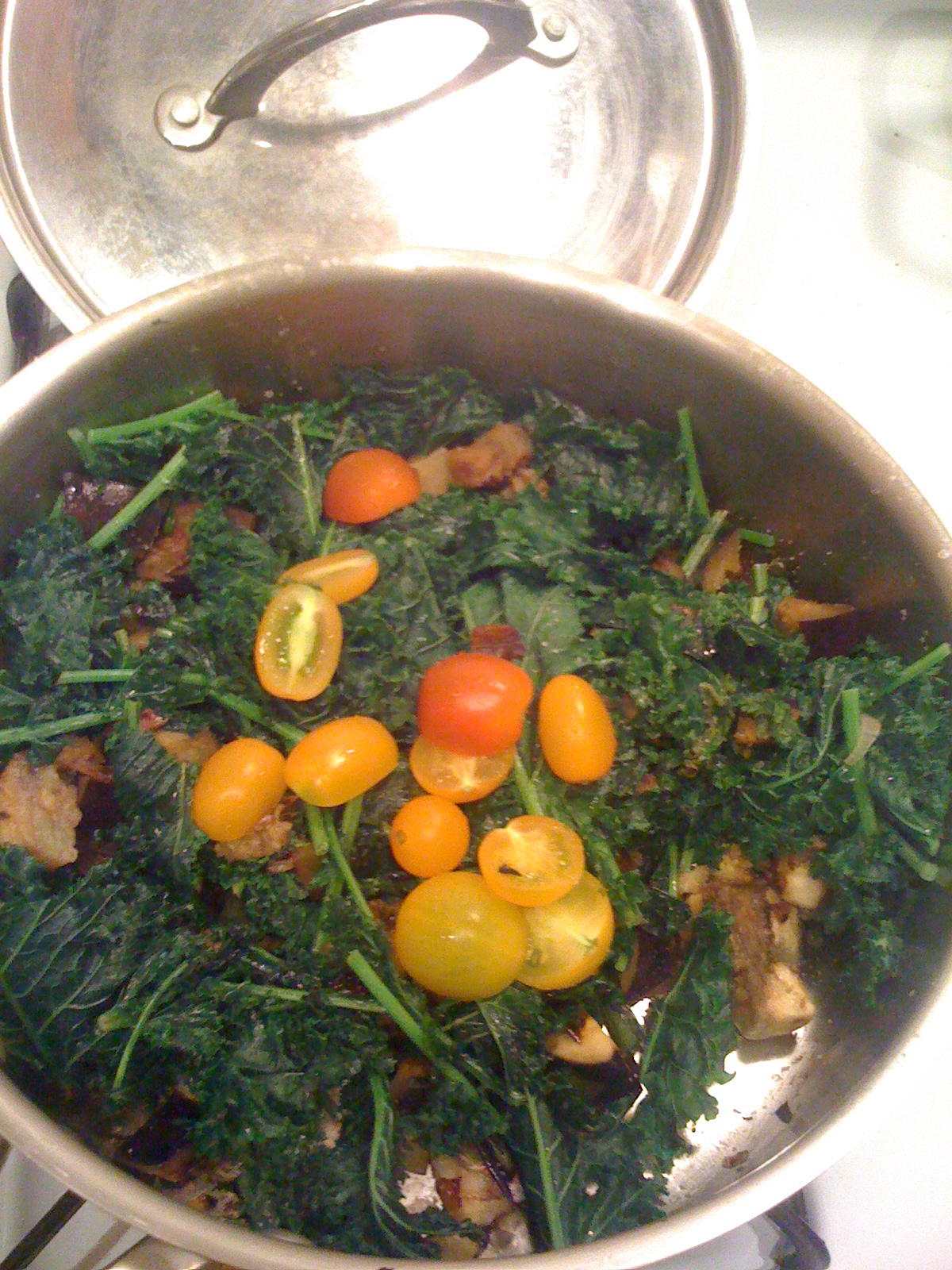
While the pan got hot I chopped one shallot and 3 leftover scapes I still had in my fridge. Threw them into the sauté pan and let that go for about 4-5 minutes until the onions browned. Meanwhile I diced and salted the eggplant then threw that into the pan. I washed and chopped a bunch of kale (it was probably 5-6 cups) and added that to the pan after the eggplant looked mostly cooked. Once the water in my pasta pot boiled I added about 1 cup of tri-color rotini, let it cook for 7-8 minutes, al dente.

Once the kale had wilted I added 1 cup of the cherry tomatoes, sliced in half, and turned the heat off. I didn’t need for the tomatoes to cook, just to get a little squishy and warm, which they did beautifully. I then drained the pasta and added it to the pan of veggies. The pièce de résistance was 4 tbsp of leftover homemade basil pesto stirred in at the end for a little kick.

The dish was gobbled up quickly. The onions were sweet and browned and stuck to the pesto which hung to the eggplant which clung to the pasta in a choreography of summer vegetable heaven. As Ina Garten might say, “You can’t beat that.”