Archives for category: Spring

Turns out, ricotta is almost easier to make yourself than it is to buy.

(Especially if you shop at Whole Foods and drive there in which case you should watch this for a good laugh.)

My friend Mark and I embarked on ricotta-making a couple nights ago; having begun around midnight, I was tucked into bed by 1 am with a pound of fresh ricotta tucked in the fridge.

Ricotta is a fresh cheese typically made from cow’s milk – it’s essentially curdled milk (and I mean that in the best possible way) and its mild flavor and creamy texture improve many a dish from breakfast to dinner to dessert. Personally I think it should be a kitchen staple the way olive oil, butter, or Parmesan are.

Springtime, and summer, are the best times for making and eating ricotta because it’s when cows are munching on fresh green grass, so the milk tastes better. Since ricotta is essentially only milk, the quality of the final product is largely determined by the milk one uses.

So depending on where you live, take the time to search out the best quality milk you can find. I’d recommend getting it from your local farmer’s market if possible; it really does make a difference in taste if the milk is whole, not homogenized, and comes from grass-fed cows. The difference is flavor in marked.

There are a few different ways to make ricotta, here is a very easy method. You’re basically boiling milk, then adding buttermilk, skimming the curds off the top, then letting them drain for half an hour to a few hours. And voilà! You’re left with a velvety, thick fresh cheese that’s delicious in a number of ways. A few of my favorites include:

*Scrambled eggs with ricotta and chives (or parsley)
*Ricotta drizzled with honey, black pepper, and walnuts
*Ricotta gnocchi served with a simple tomato or Romesco sauce
*Prosciutto-wrapped ricotta and melon
*Penne with ricotta, tomato, and basil
*Orecchiette with peas, mint, and ricotta
*Ricotta cheesecake served with fresh berries
*Ricotta pancakes with maple syrup, jam, or berries

Fresh Ricotta

1/2 gallon milk
1 pint buttermilk
olive oil
zest of 1/2 lemon
salt

(Makes 1 pint ricotta)

Bring the 1/2 gallon of milk to nearly a boil in a large sauce pan or stock pot. Pour in the buttermilk, turn the heat down to low, stir continuously, and lo and behold the curds will begin to form instantly before your eyes. After 2-3 minutes turn off the heat.

Line a colander or fine-meshed sieve with two layers of cheesecloth and place over a bowl. With a slotted spoon skim the curds from the pot and transfer to the colander. You can discard the liquid (whey) remaining in your stock pot or tell me if you know a great way to use it. Leave the cheese curds to drain for at least a half hour and up to a few hours. The whey remaining in the curds will drain into the bowl and you’ll be left with ricotta.

At this point you could be done and enjoy your ricotta, or you can continue with a couple extra steps for an added boost of flavor:

Once the ricotta has been drained, I recommend transferring to a food processor or bowl and mixing with a pinch of salt, the zest of half a lemon, and 2-3 tbsp extra virgin olive oil. I also liked cracked black pepper, but this can be added at the time of serving.

So remember, if you can buy milk, you can make ricotta. If you can buy good milk, you can make excellent ricotta.


I’ve been wanting to try Jean-Georges Vongerichten’s ABC Kitchen ever since it opened a little over a year ago in ABC Carpet & Home in the Union Square/Flatiron neighborhood of New York.

A celebrated chef, known for his elegant, dare I use the word ‘fusion,’ of classic French techniques with the flavors of other lands—Japan, or in this case, upstate New York—Jean-Georges has opened restaurants all over this city, most of which are successful (Jean-Georges, Perry Street, Mercer Kitchen) and only one or two considered misses perhaps (Vong, Spice Market).

ABC Kitchen is his version of capturing the gastronomical zeitgeist – casual, local, seasonal, downtown, and affordable (relatively speaking), as some chefs of his ilk have done of late (Daniel Boulud’s DBGB comes to mind). I don’t normally wish for chefs to expand their restaurant empires or jump on food trends, but I do wonder what Eric Ripert of Le Bernardin or Dan Barber of Blue Hill would do with more casual offshoots of their formal flagship restaurants. Of course, I don’t want either of these upstanding chefs to dilute the strength of their focused efforts, I just fantasize about the possibility of a weekday lunch of, say, a Fin Dorset lamb sandwich with garlic scapes and micro arugula (at my imaginary Blue Hill); or yellowfin tuna, shaved chives, and olive oil layered on a toasted baguette (at make-believe Le Bernardin).

ABC Kitchen promises a changing menu based on the seasons and local produce surrounding New York. The produce is reared without exposure to synthetic fertilizers or pesticides (the culinary equivalent of television); the meat and fish are pasture-raised, or line-caught, or sustainably harvested; the dairy is free of antibiotics, from animals treated humanely and fed a free-roaming diet of grass and probably coconut water.

My first view into the restaurant was on the Sundance Channel’s Iconoclast program last year, on an episode with Jean-Georges and Hugh Jackman, where the two prepare a charity dinner at the newly opened ABC Kitchen. Furnished with wares that can be purchased at ABC Carpet & Home, including the tables, chairs, bowls, plates, stemware, flower vases, and lighting fixtures, the restaurant has a comfortable, urban farmhouse feel about it. Downtown meets Upstate. French fries meet foie gras. Fine dining meets…ABC Carpet.

My dining companion once again was my friend Sarah (of Sunday’s Roman’s adventure), in town briefly from Vancouver. I made the reservation one week prior to our lunch which, to my relief, was plenty of time to book a 1 pm table on a weekday. The first thing I noticed upon our arrival was the gracious efforts of the host and the light-hearted chattiness of the fellow who escorted us to our table (“isn’t this weather so fresh?”)

I often have difficulty deciding what to order, especially if I know I may not return to a restaurant before the menu changes. In this case indecision would be an understatement. The cocktail menu alone included an entire section on fresh-squeezed vegetable-herb juices, fresh-fruit smoothies, and homemade sodas infused with herbs and citrus. I’m surprised they weren’t serving kombucha on tap! I opted for the coconut water and Sarah chose a dry, acidic white wine.

I love a restaurant companion who enjoys sharing plates as much as I do. That way you get to try twice as many items on the menu than you would if eating separate dishes. Sarah was game, so for our first course, we ordered the sweet pea soup with carrots and mint and the roasted carrot and avocado salad with crunchy seeds. It was difficult neglecting the appetizer of raw diver scallops with sea beans and serrano chilies and the crab toast with lemon aioli. We’d stare at waiters passing by with dishes for other tables to assess whether we’d made good decisions. (The crab toast, I have to say, being devoured by a neighboring table, looked quite good.)

I half-expected the pea soup to arrive chilled, but bucking that trend it is served hot, a bright green purée with crunchy pesto croutons and what tasted like the zest of lime. The salad was an abundance of micro greens (that may have been grown on the restaurant’s rooftop garden) sitting atop two perfectly roasted whole carrots, with quarters of ripe avocado.

For our main courses, we chose the steamed hake with roasted maitake, asparagus and spring onions; and the asparagus and heirloom tomato sandwich on focaccia with mozzarella and what I remember as pickled onions or radishes, hot peppers, and a side of house-cut french fries dusted with fresh rosemary and salt.

We lingered over the flavors of our first course for so long that we were startled out of our oohs and ahhs by our server bringing the second course before we were done with the soup and salad. They asked to clear our first-course plates when Sarah and I simultaneously and defensively pulled them in close and asked to keep them. I couldn’t discard the three spoonfuls of soup left or the tiny nub of roasted carrot remaining on the plate!

The second course did not disappoint. The focaccia was a soft and salty foil to the heat of the peppers and pickles, the mozzarella a smooth and silky pillow for the ripe red tomatoes. Olive oil oozed over my hands as I took big bites, taking care to get each layer of the sandwich in each mouthful. The hake was flaky, moist, infused with a light vinaigrette and when eaten together with the maitake produced the perfect bite. The asparagus was diced into tiny round pieces laying underneath and on top of the hake filet.

We were entirely too full to tackle dessert but coveted our neighbor’s sundae of vanilla ice cream with caramel and popcorn. Next time. Because this is, after all, Jean-Georges downtown, so there can be a next time.

It all started with a corn tortilla. Not just any corn tortilla. The Hot Bread Kitchen handmade corn tortillas lovingly pressed by hand and cooked over a hot comal.

My friend Mark loves these tortillas, and tortillas in general. So when I saw them at the co-op last week I couldn’t resist picking up a package of six. (They sell these at the greenmarket in Union Square on Wednesdays too.) I figured they’d go well with all the black turtle beans in our cupboard, if nothing else.

So finally this weekend Mark and I had the opportunity to cook together – we had previously soaked and cooked the black beans so that part was done. They were fragrant with bay leaves and garlic. Feeling ambitious, despite the late hour we were starting, we decided on enchiladas, rather than what would have been the quicker (but perhaps less gratifying) tacos with beans. With spring onions and asparagus in the fridge from a recent greenmarket purchase, we decided on braising these in the oven as a side dish.

The fridge and spice cupboard revealed the additional makings for the enchiladas; there was Carr Valley Bread Cheese from Murray’s Cheese (it’s a Finnish-style, mild, oven-baked cheese), and the true stars (and work horses) of this dish: Guajillo Chili Peppers from Penzeys Spices and Happy Quail Farms Pepper Chips from the San Francisco Bay Area, transported to Brooklyn on Mark’s carry-on recently.

The first thing we had to do was soak the peppers in a hot water bath – this becomes the basis for the spicy enchilada sauce. We boiled 1-2 cups of water in the kettle then poured it over the peppers in a bowl, and let soak for 20 minutes.

Peppers hydrating in hot water

As these were soaking I added the onions to a cold water bath to thoroughly clean these sandy alliums for our vegetable side dish. I changed the water once or twice to make sure they were free of all grit then patted dry.

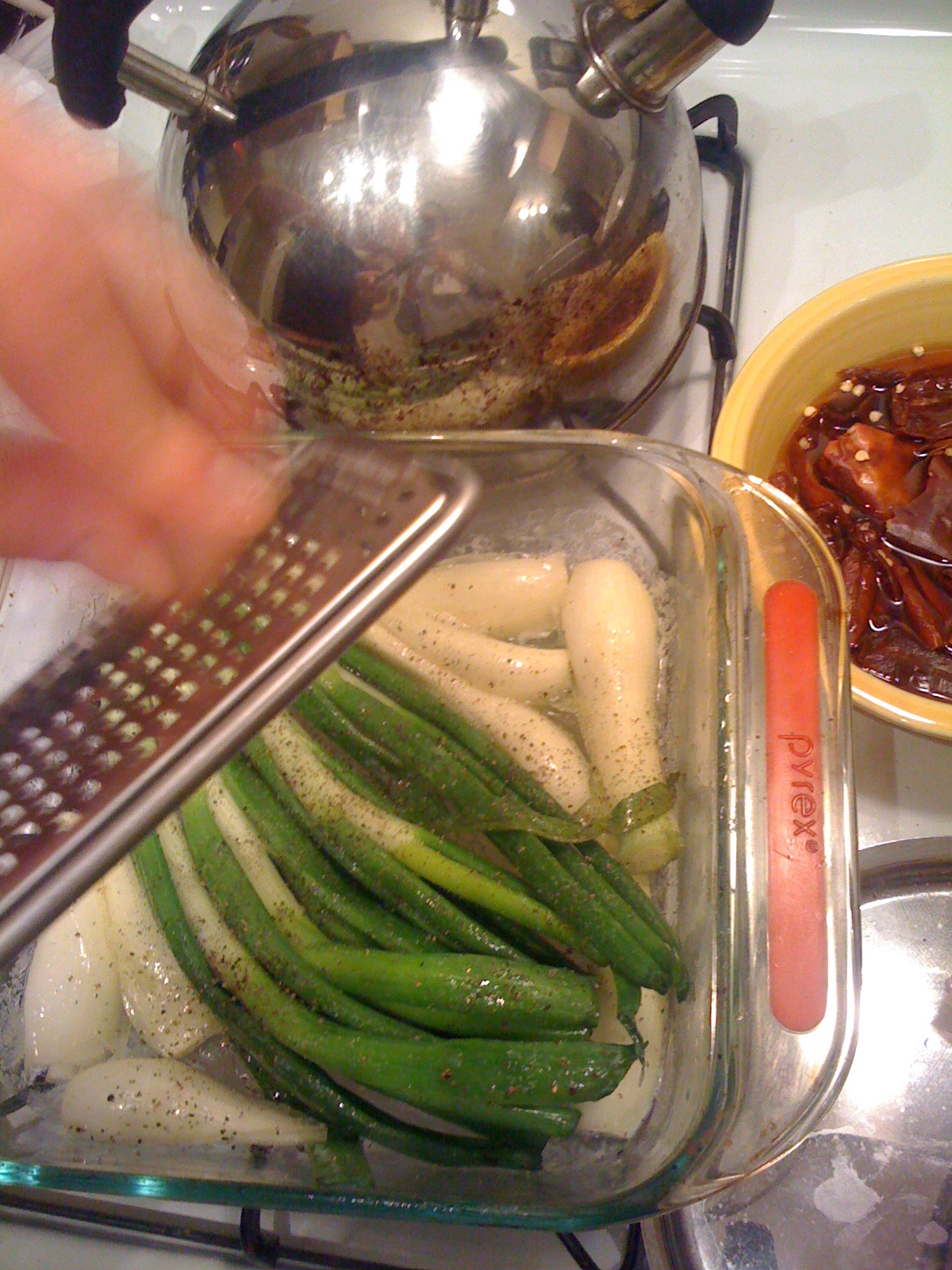
I pre-heated the oven to 400 degrees and into a glass casserole dish went 3 tbsp unsalted butter, 1/2 c white wine, and the onions (with green tops and all). Mark grated some fresh nutmeg over the onions, and added salt and lots of freshly ground black pepper. Then into the oven, uncovered, for 20-25 minutes. I washed the asparagus stalks (about 1/2 pound) and set aside (these guys will get steamed and later added to the onion dish).

Grating nutmeg over the onions

Back to the enchiladas…now comes the fun part. Using a food mill we puréed the peppers over a large bowl (liquid and all) for what seemed like quite a long time – just when I’d think I couldn’t possibly squeeze anything else from these peppers Mark would say gently, “Just a little more.”

Transferring the peppers to the food mill

Puréeing the peppers

When there really was little life left to squeeze out of the peppers we added an 8-ounce can of tomato sauce – this thickens the overall sauce, adding more body and, crucially, tempers the heat. We also then slowly added somewhere between 4-5 tbsp of olive oil.

Adding olive oil to the puréed tomato-pepper sauce

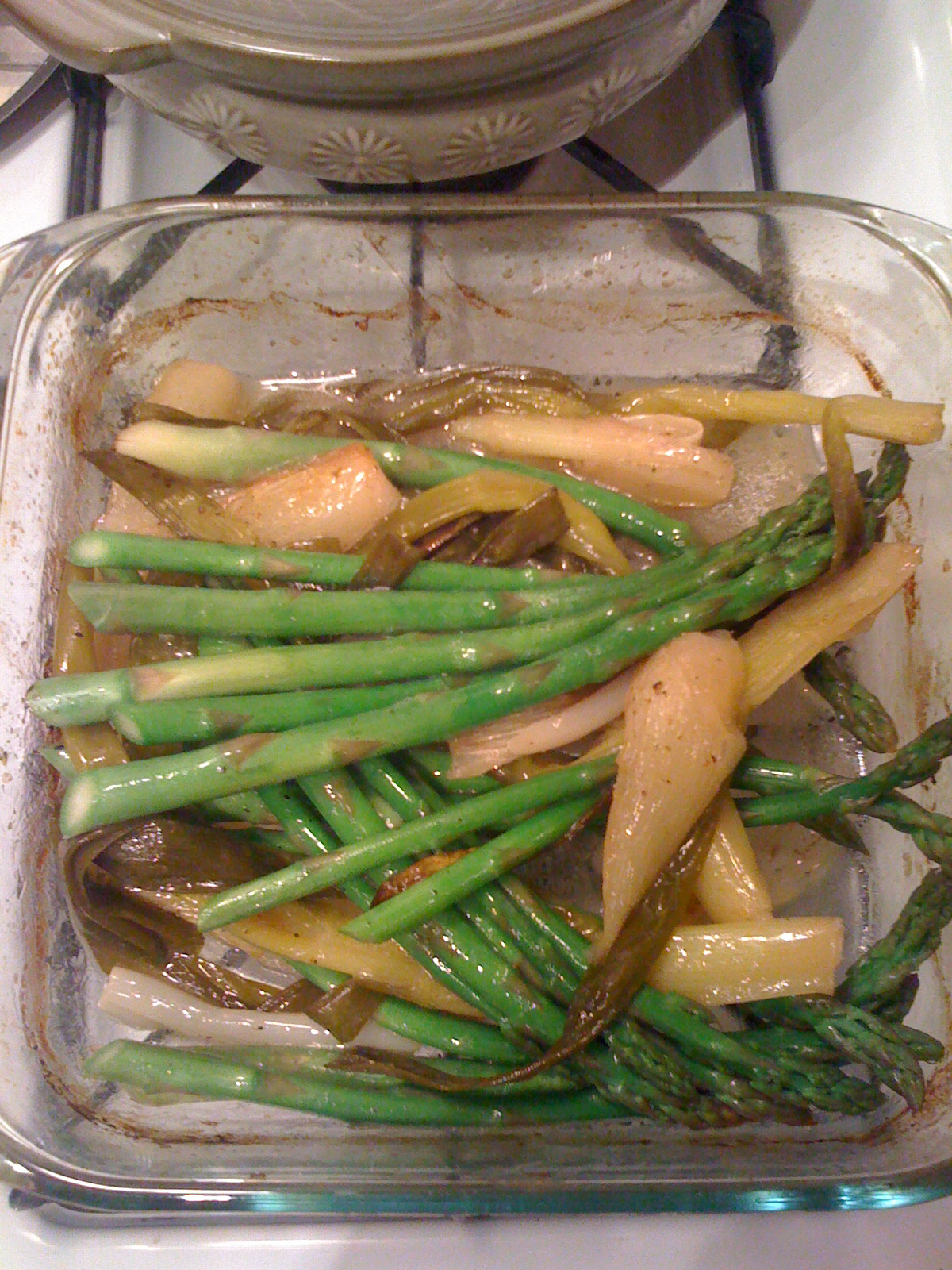
At this point it was time to remove the braised onions from the oven and steam the asparagus on the stovetop for five minutes. We added the asparagus to the baking dish and mixed it with the lovely juices of the braising liquid and onions. Keep warm, set aside.

Asparagus and spring onions in white wine and butter

It was almost time to soak the tortillas in the sauce – but the sauce was still fiery hot so we added about 2 tbsp honey to smooth out the flavor. It still packed a lot of heat but not unbearably so. Then we added the tortillas to the sauce to soak them and make the tortillas more pliable (you wouldn’t want to soak as long with fresh or homemade tortillas, but these HBK ones come refrigerated so they’re not quite malleable) and absorb the flavors. We couldn’t get them soft enough to roll up entirely, so we decided to leave them in the shape of a taco, half-folded.

Tortillas meet sauce

We coated the bottom of a cast-iron skillet (it was either a 10- or 12-inch pan) with a bit of the sauce then folded each tortilla and placed in the skillet. To each tortilla we added slices of the cheese then the black beans. We topped the whole dish off with the remaining fiery sauce before putting into the still-hot 400-degree oven for 15-20 minutes.

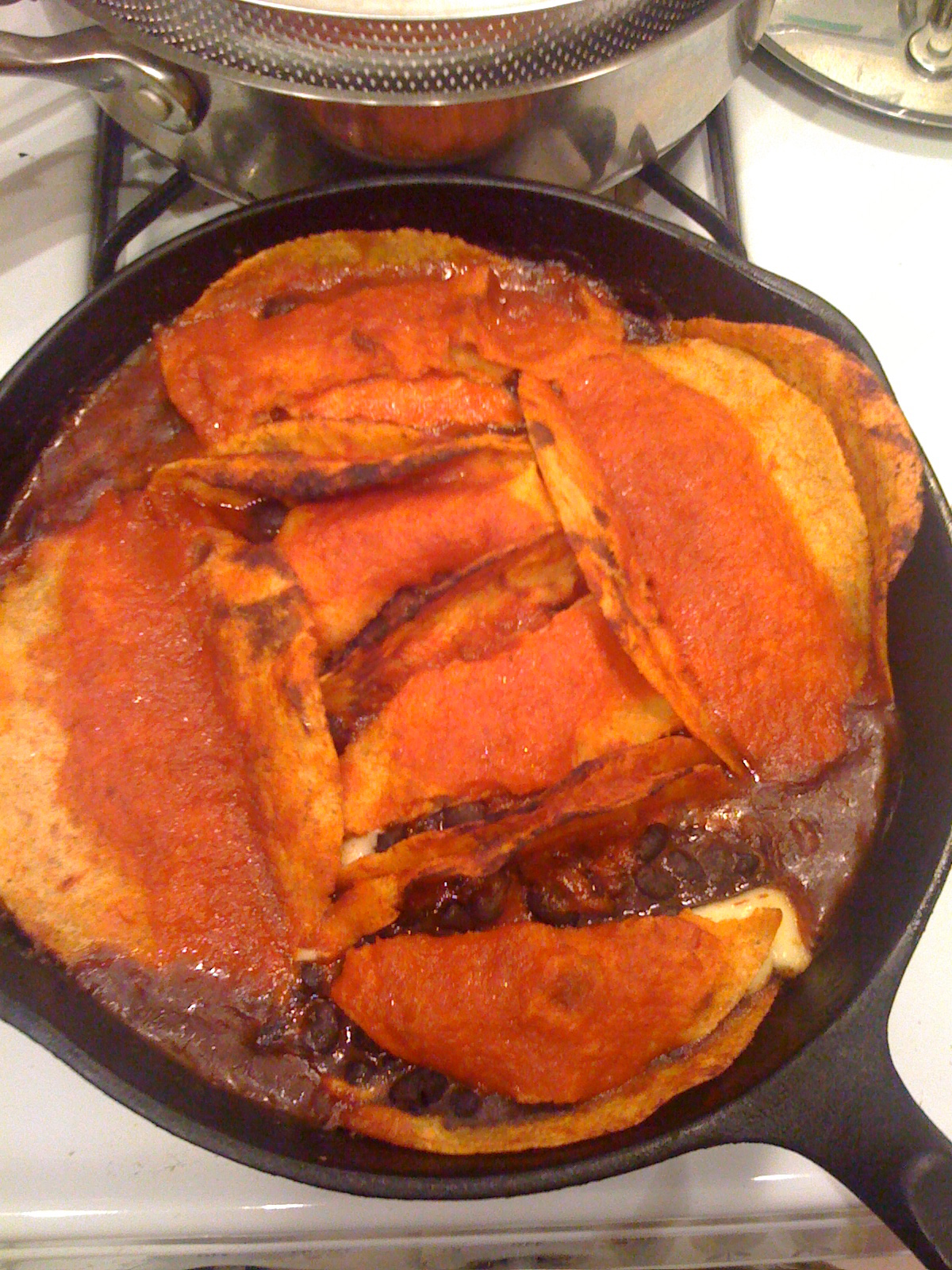
When I checked on the enchiladas the tortillas had turned a crispy brown and the beans were bubbling along with the melted, creamy cheese.

When ready to serve we squeezed fresh lime over the enchiladas and dove in. Served with the spring onion-asparagus dish we had ourselves a mouthwatering, eye-watering,  good meal. It was topped off by a dessert of Mark’s homemade strawberry shortcake, a cool finish to the evening somewhere ’round midnight.

Hot enchiladas in the skillet