Archives for category: Beans

That’s right. This is supposedly the best vegetarian chili in the world. It’s adapted from a popular recipe on allrecipes.com and I have to say, it’s mighty tasty. Shout out/apology to my cousin Bill, a chef in Texas, who might take issue with the idea that chili can even be vegetarian let alone mighty tasty.

Alright, for starters, it’s been cold here in New York the past two weeks. After tackling the carrot soup thing I wanted more stick-to-your-ribs fare but I haven’t been buying or cooking much meat. So instead of braised short ribs, beef bourguignon, or polenta with sausage ragù, I went with a chili packed with beans, veggies, spice, and all the warmth with none of the meat.

The original recipe called for an inordinate amount of jalapeños and chopped green chile peppers so I toned these down and my version still had a little kick. You could add a few dashes of tabasco to your bowl if you find it’s lacking heat. The recipe also called for such oddities as ground Boca burgers – I cut these out and increased the veggies. And of course, if possible, start with cooked dried beans instead of cans but don’t worry about it if you buy canned.

Vegetarian Chili
Adapted from allrecipes.com
Serves 8

1 tbsp olive oil
1 medium yellow onion, chopped
2 bay leaves
2 tsp ground cumin
2 tbsp dried oregano
1 tbsp salt
3 stalks celery, chopped
2 green bell peppers, chopped
1 jalapeño pepper, chopped
3 cloves garlic, chopped
1 (4-oz.) can chopped green chile peppers, drained
3 (28-oz.) cans whole peeled tomatoes
1/4 cup chili powder
1 tbsp ground black pepper
1 c cooked (or 1 15-oz. can) kidney beans
1 c cooked (or 1 15-oz. can) garbanzo beans
1 c cooked (or 1 15-oz. can) black beans
1 package (15-oz.) frozen whole kernel corn

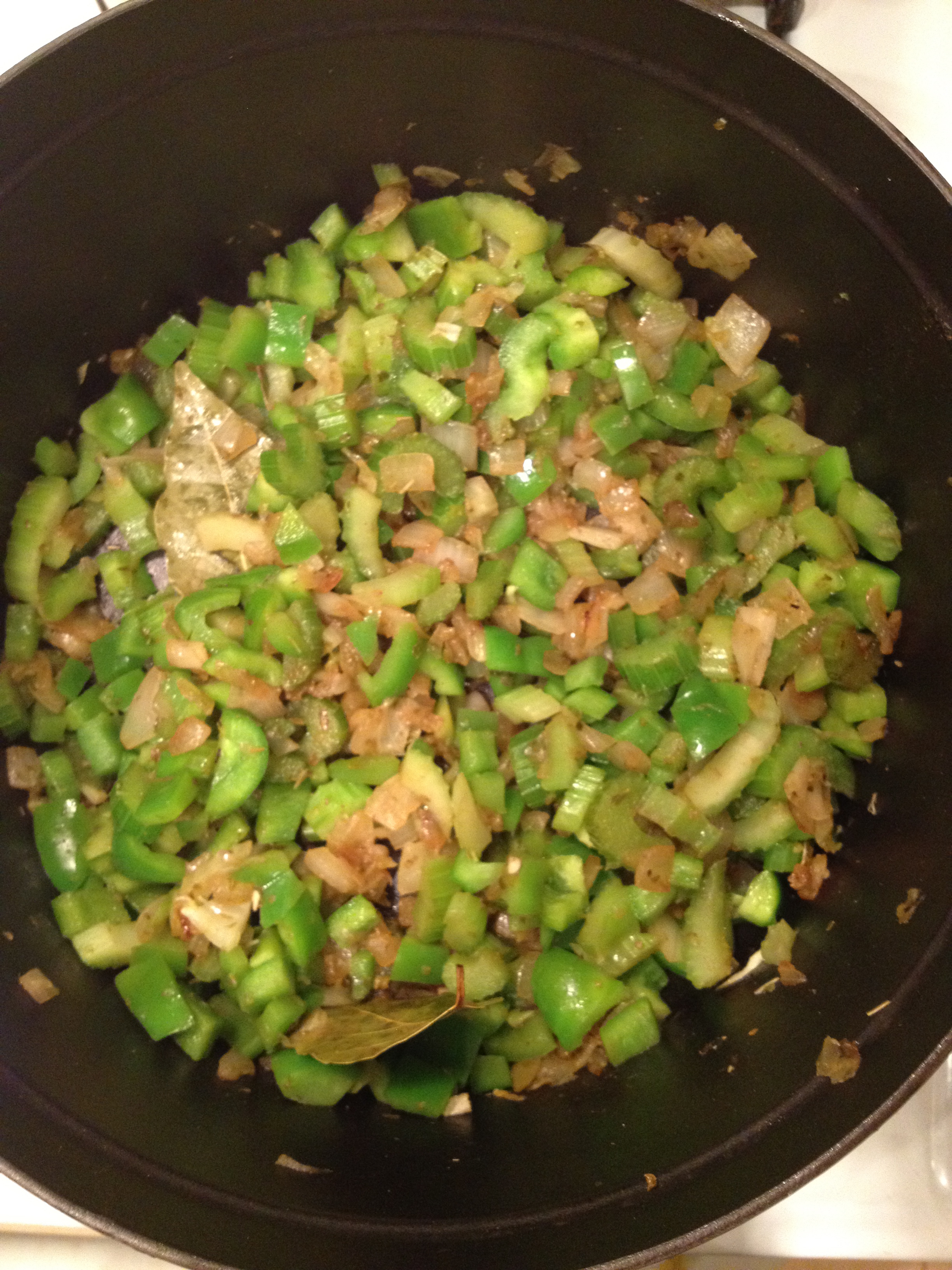
Heat the olive oil in a large pot over medium heat. Stir in the onion and season with bay leaves, cumin, oregano, and salt. Cook and stir until onion is tender, then mix in the celery, green bell peppers, jalapeño, garlic, and green chile peppers. Cook for another 10 minutes or so until the celery and bell peppers have softened.

Mix the tomatoes into the pot, breaking them up into smaller pieces. Season with chili powder and black pepper. Stir in the kidney beans, garbanzos, and black beans. Bring to a boil and, if there seems to be a lot of liquid, let it boil until some of the liquid evaporates, roughly 10-25 minutes. Then lower the heat and simmer for additional half hour or so. Whether you have a lid on or not depends on if or how much you want liquid to evaporate. Stir in the corn five minutes before turning off the heat.

Serve with a dollop of sour cream, creme fraiche, or shredded cheese, sliced scallions, and maybe some avocado. I also served this with broccoli that had been roasted in the oven on 400 degrees for 25 minutes and tossed with olive oil and salt.

Heirloom beans are romantic, beautiful, and actually good for the soil and your body. So what’s not to like?

So says Steve Sando, founder of Rancho Gordo, a farm based in Napa, California that grows heirloom beans and produce. I couldn’t agree more. I mean, even the names are romantic: Good Mother Stallard Beans, Jacob’s Cattle Beans, Eye of the Tiger Beans, European Soldiers, Red Nightfall, Yellow Indian Woman, Scarlet Runners, Rio Zape, and Black Valentines. Rancho Gordo is the big pinto in town. One of his most ardent fans is Thomas Keller, who uses the beans in all of his kitchens, from the French Laundry to Per Se.

Last week, with New Year’s Eve on the horizon, I decided to pull out the Rancho Gordo cookbook, Heirloom Beans, and see what Sando had to say about making a big pot of warm, hearty soup. Traditonally, in the southeastern United Stations anyway, it’s good luck to eat beans on New Year’s day, particularly black-eyed peas. For New Year’s Eve company, I settled on a spicy-sounding Caribbean black bean soup with roasted garlic and tomatoes. Just the thing to ring in the new year and warm up a cold night.

2012 is gonna be an excellent year, don’t you think?

Caribbean Black Bean Soup with Roasted Garlic and Tomatoes
Serves 4

6 garlic cloves, unpeeled
2 tbsp olive oil, plus more for drizzling
4 whole fresh or canned plum tomatoes, with juice
salt
1/2 lb black valentine or black beans, cooked, with reserved broth*
1/2 medium yellow or white onion, chopped
1 jalapeño pepper, chopped
1 medium carrot, chopped
1 1/2 tsp cumin seeds, toasted and ground
1 tsp dried oregano
1/2 tsp cayenne pepper
2 c chicken or vegetable broth**
freshly ground black pepper
sour cream, for garnish
1 avocado, pitted and sliced, for garnish
fresh cilantro leaves, for garnish

*I’d recommend cooking your beans by first soaking them for a minimum of 2 hours and maximum of overnight, covered with about 2 inches of water. (Actually first make sure you rinse them thoroughly and pick out any pebbles.) After soaking, pour the beans with their soaking water into a large pot, covered by about 1 inch of water (or stock). For flavor you can add a carrot, celery stalk, fennel bulb, onion, leeks, whole garlic cloves, black peppercorns, bay leaf, juniper berries, mustard seeds. You can also keep it simple and not add much. Just don’t add salt until after they’re cooked. Bring the beans and water to a boil then reduce heat to a simmer, with a partial lid, and cook until done, which can take as little as 1 hour or as much as 3 hours.

Preheat the oven to 400 degrees F.

Put the garlic cloves on a sheet of aluminum foil and drizzle with olive oil. Wrap the foil. Put the tomatoes in a baking dish, and if using fresh tomatoes, cut them in half and put them cut side down in the dish. Season with salt and drizzle with olive oil. Roast the garlic and tomatoes until soft, fragrant, and brown, about 20 minutes.

Meanwhile, put the beans and their broth in a soup pot and warm over low heat.

**I recommend making your own broth. For a quick vegetable broth I brought about 1 quart of water to a boil in a stock pot with 1 carrot, cut in half, 1 onion, also halved, 1 fennel bulb, halved, 1 celery stalk, halved, 1 clove of garlic, smashed, and a little satchel of spices: black peppercorns, mustard seeds, juniper berries, and cumin seeds.

In a medium, heavy skillet over medium-high heat, warm the olive oil. Add the onion, jalapeño, and carrot and sauté until fragrant and beginning to caramelize, about 10-12 minutes. Add the cooked vegetables, cumin, oregano, cayenne, and broth to the beans.

Peel the roasted garlic cloves; chop the garlic and tomatoes coarsely and add to the beans. Season with salt and pepper to taste. Bring to a simmer over medium-low heat and cook until the vegetables are soft and the flavors are blended, about 15 minutes.

Let the soup cool slightly, then transfer about half to a blender and blend until smooth. Return the soup to the pot and stir to combine. Season to taste. Serve the soup garnished with sour cream, avocado, and cilantro. Corn bread would make a nice side dish.

Been too long since my last post.

It’s not that I haven’t been eating anything good, just nothing too post-worthy, but also I’ve just been busy. Working, occupying Wall Street, taking care of Grandma, studying Japanese. Even for me food can sometimes take a back seat. But not for long!

My slump changed on Saturday when a friend brought over last-of-the-season squash blossoms from the farmers market. The first time I had these babies was in Rome when I lived there back in 2003. I seem to remember they were something of a speciality in the city, especially stuffed with mozzarella (and sometimes anchovies), battered, and fried. In fact, that’s the only way I’d ever had them, from Rome to New York to Vermont.

But in a bold and unexpected move, my friend decided to serve them raw. She brought over a mixture of avocado and tomato and assembled them at the kitchen table, neatly spooning them into the cleaned blossoms. I was waiting for her to nudge me out of the way at the stove and start frying – I assumed they must be fried! – but she had us roll them up and bite in, unadorned by batter or copious oil. The avocado was a soft and creamy contrast to the somewhat sturdy petals of the blossom and the tomato provided just the acidic bite to round out the flavors.

So sometimes zucchini can get a bad rap. I’ve heard it referred to as a swollen ovary, immature fruit, and just plain nuisance. (My goodness, would you kiss your mother with that mouth?) It seems the supply and demand ratio is a bit off come August–September, with an over-abundance leading otherwise perfectly civilized folks to “zucchini” their friends, neighbors, and total strangers by leaving bags of the stuff in cars and on doorsteps. It’s a pastoral version of “ring and run.”

For those that don’t know, squash blossoms are  just that – the flower that blooms from both the male and female squash, and typically we’re eating the flowers from zucchini specifically. As I mentioned, they’re often served stuffed and then fried or baked, but you want to remove the pistils first from the female flowers and stamens from the males.  I mean, who wants to eat reproductive organs with dinner? And you can eat the whole flower but avoid the hard and fibrous stem.

(Here’s a recipe from Saveur that I like.)

We served the stuffed blossoms as a first course to a meal that included white beans simmered with turmeric, coriander, and chile; a pork roast with a rub of cumin, black pepper, and fennel seeds; and sauteed kale with cayenne, lemon and garlic. I think these may in fact have been the only swollen ovaries I had all summer, and according to signs at the farmers market last week, they will be my last, until next summer. Serves us right I suppose, for all the slandering of excess zucchini all summer long, that we should be denied any for another year. Who you calling swollen?